Recap:
So far in our study of Genesis we have looked at time and eternity, and the creation of the heavens, the earth and light. We saw that light was separated from darkness, and the earth from the water. We then covered the creation of plants and trees, and the Sun, Moon and stars.
We’ll read verses 11, then 20, then 24-25:
11 Then God said, Let the land produce vegetation: seed-bearing plants and trees on the land that bear fruit with seed in it, according to their various kinds. And it was so.
20 And God said, Let the water teem with living creatures, and let birds fly above the Earth across the expanse of the sky.
24 And God said, Let the land produce living creatures according to their kinds: livestock, creatures that move along the ground, and wild animals, each according to its kind. And it was so.
25 God made the wild animals according to their kinds, the livestock according to their kinds, and all the creatures that move along the ground according to their kinds. And God saw that it was good.
Well you either believe that God created every living thing in the space of a few days, or you don’t. Some believe in Theistic Evolution: believing that although God created, he used Evolution to produce everything we see today.
Immediately to my mind then come some questions:
Could God have created everything exactly as recorded?
If the answer to that is no, what is limiting God who is actually all-powerful?
Did God need to use evolution?
Let’s read about when God first called Moses to lead his people.
Moses was not happy! – read Exodus 4:1-5
1 Moses answered, ‘What if they do not believe me or listen to me and say, “The Lord did not appear to you”?’
2 Then the Lord said to him, ‘What is that in your hand?’
‘A staff,’ he replied.
3 The Lord said, ‘Throw it on the ground.’
Moses threw it on the ground and it became a snake, and he ran from it. 4 Then the Lord said to him, ‘Reach out your hand and take it by the tail.’ So Moses reached out and took hold of the snake and it turned back into a staff in his hand. 5 ‘This,’ said the Lord, ‘is so that they may believe that the Lord, the God of their fathers – the God of Abraham, the God of Isaac and the God of Jacob – has appeared to you.’
How long did it take God to make the snake? (And Moses certainly knew it was real – he ran from it!)
Evolution also contradicts Genesis 1:24-25, and Wayne Grudem (Systematic Theology, chapter 15, p277) satirically suggested that this passage should read: let the earth produce living creatures according to their kinds, and after 387,492,871 attempts God finally made a mouse that worked. And he said it was quite good, but he could probably improve it a bit.
But seriously, of all the difficulties I have with the Theory of Evolution, the greatest has to be with the whole subject of DNA. Every truly living organism has to have DNA, however small and ‘primitive’ it may be. Not only is this DNA used to maintain each cell, but it also contains the blueprint of the organism (the simplest of which are probably bacteria cells), in order that as it reproduces it creates an exact replica of the original.
But not only did the very first cell need the DNA blueprint to replicate itself, even the simplest of cells also needs a mechanism to decipher the incredibly complex code that it contains. This could be imagined as a computer program, which can read the data contained in the sequences of DNA and then instruct each part of the cell to grow exactly as specified. And so far I have not found any satisfactory explanation of how it could have evolved in order for the first cell to reproduce. (There is a basic description at the end)
The more I look into this single topic, with its incredible complexity of protein synthesis, and the fact that DNA also has its own inbuilt maintenance and repair mechanisms which are carried out automatically and continually, I can only conclude that there has to have been a designer.
Before we leave this topic I should point out that within DNA is the provision for adapting to circumstances. It is possible to selectively breed more successful forms such as farm animals, crops, domestic animals or plants. This is not evolution but selection; the data for each of these variations is contained in the genes, but no data exists to change into another type – wheat is still wheat, dogs are still dogs.
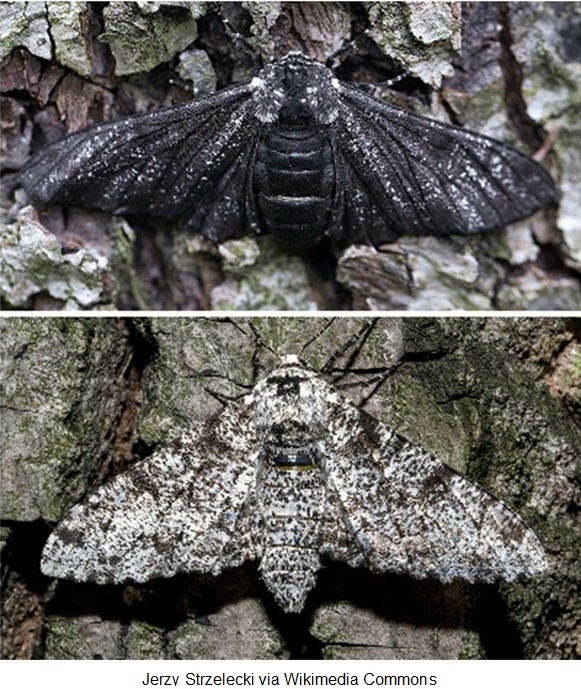
The Peppered Moth mimicked the colour of light lichens on its roost trees. During the Industrial Revolution dark forms were gradually selected out to merge with smoke blackened trees. (Light versions were easily seen and eaten). Since smoky factories have become a thing of the past, the lichens have become light again and so have the moths.
So we return to Creation:
How long did God need in Man-Time to produce all living things? Or did he take as long as he needed in God-Eternity, and then said ‘let it be so’?
I can only take a view that as God is God, that is just what he did.
But something else was also needed and for this we return to verse 2 where we read:
the Spirit of God was hovering over the waters
The Holy Spirit was present at creation to breathe life into all living things. What is life? When I looked at the Pear tree that had been happily growing in our garden and found it had died, what was now different about it to when I had last seen it? It had baby pears growing, all its roots were still there; all its cells were in place, why was it not still living? What is life?
(Wait for answers!)
It is the work of the Holy Spirit to give life.
Read Psalm 104:24, 29-30
24 How many are your works, O LORD!
In wisdom you made them all; the earth is full of your creatures.
29b When you take away their breath, they die and return to the dust.
30 When you send your Spirit, they are created,
and you renew the face of the earth.
And John 6:63:
The Spirit gives life; the flesh counts for nothing. The words I have spoken to you are spirit and they are life.
So finally we can come to Genesis 1:26-27
26 Then God said, Let us make man in our image, in our likeness, and let them rule over the fish of the sea and the birds of the air, over the livestock, over all the Earth, and over all the creatures that move along the ground.
27 So God created man in his own image,
in the image of God he created him;
male and female he created them.
So men (and women) were finally created, but there was something different about them – they were made in the image, in the likeness of God.
What does it mean in verse 27: God created man in his own image ?
Again, wait for answers!
It does not mean that God has a physical body like a human being. The Bible describes God as a Spirit (John 4:24) so it can’t mean that.
But how about the nature of God? can we somehow mirror his nature?
Think of some aspects of our nature that are different to other animals – and so must be a reflection of God’s nature (Get people to call out, rather than just tell them!)
- Thinking: We have the ability to reason, think, solve problems, and communicate complex ideas.
- Morals: We have a conscience, an inner sense of right and wrong, and the capacity for ethical judgment.
- Spirituality: We have a capacity to know, worship, and have fellowship with God.
- Creativity: We have the ability to innovate and create new things.
- Free Will: We have the capacity to make genuine choices.
We also instinctively consider that other humans must be valued. Crimes against humanity are taken very seriously.
Perhaps it’s good to remember that Christ is the image of the invisible God, the firstborn over all creation. (Colossians 1:15)
And also that: we, who with unveiled faces all reflect the Lord’s glory, are being transformed into his likeness with ever-increasing glory, which comes from the Lord, who is the Spirit. (2 Corinthians 3:18), that we are predestined to be conformed to the likeness of his Son (Romans 8:29), and that: we know that when he appears we shall be like him, for we shall see him as he is. (1John 3:2)
Now verses 28-31
28 God blessed them and said to them, Be fruitful and increase in number; fill the Earth and subdue it. Rule over the fish of the sea and the birds of the air and over every living creature that moves on the ground.
29 Then God said, I give you every seed-bearing plant on the face of the whole Earth and every tree that has fruit with seed in it. They will be yours for food.
30 And to all the beasts of the Earth and all the birds of the air and all the creatures that move on the ground— everything that has the breath of life in it— I give every green plant for food. And it was so.
31 God saw all that he had made, and it was very good. And there was evening, and there was morning— the sixth day.
This is what it had all been for. But why should God want to create Mankind?
We are told in Isaiah 43:6,7
6 I will say to the north, ‘Give them up!’
and to the south, ‘Do not hold them back.’
Bring my sons from afar and my daughters from the ends of the earth—
7 everyone who is called by my name,
whom I created for my glory, whom I formed and made.”
We were created for God’s glory, and our purpose in life is: whatever you do, do it all for the glory of God (1 Corinthians 10:31)
And Ephesians 1:4-6
4 For he chose us in him before the creation of the world to be holy and blameless in his sight. In love 5 he predestined us to be adopted as his sons through Jesus Christ, in accordance with his pleasure and will—6 to the praise of his glorious grace,
Back to verse 28
28 God blessed them and said to them, ‘Be fruitful and increase in number; fill the earth and subdue it. Rule over the fish in the sea and the birds in the sky and over every living creature that moves on the ground.’
Verse 27 emphasised three times the fact that we are not an accident; we were created by God in his image. And verse 28 says that both men and women share God’s blessing.
OK then, what does ‘God blessed them’ (v28) mean?
A statement that God would not only provide for them all good things (1 Timothy 6:17) but that of all his creation, humankind was unique – being made in the likeness of God – and we would always be particularly cared for by him. It may be helpful to consider that it is the exact opposite of ‘God cursed them’.
But in return what responsibilities were we given v28?
Be fruitful and increase in number;
Fill the Earth and subdue it.
Rule over the fish of the sea and the birds of the air and over every living creature that moves on the ground.
1) It was important that the spread of mankind throughout the world would match that of the rest of creation. All animals and plants have an inbuilt desire to reproduce and this is true of Humans too – but they also have free will and needed direction from God. Note that in this perfect world, there was no degradation of the genetic material and so intermarriage was not a problem.
2) What could ‘subdue it’ mean? The Created world contained all plants, animals, and minerals for our benefit – but we would have to learn how to control them for our use. Selective breeding would produce the best varieties for different circumstances, and every scientific discovery is only discovering something that God placed there at creation! But we still need to learn how to put them to best use.
3) And what does ‘Rule over’ mean? Here we are given authority over all animal life. We are to understand our position in the created order, but our decisions must be fair and just, taking into account the needs of all.
Plant life was not included in this – but plants were for our use, particularly for food. Originally all animals were vegetarian:
Read Genesis 1:29-30
29 Then God said, I give you every seed-bearing plant on the face of the whole Earth and every tree that has fruit with seed in it. They will be yours for food.
30 And to all the beasts of the Earth and all the birds of the air and all the creatures that move on the ground— everything that has the breath of life in it— I give every green plant for food. And it was so.
And for Mankind, this remained so until after the Flood (Genesis 9:3).
Read Genesis 1:31
31 God saw all that he had made, and it was very good. And there was evening, and there was morning— the sixth day.
God looked at his creation and decided that in his view it was very good. No need for hyperbole – ‘it was very good’ says it all. Actually, the more you think about the incredible complexities of creation the more you can understand exactly what God was saying.
Read Genesis 2:1-3
1 Thus the heavens and the earth were completed in all their vast array.
2 By the seventh day God had finished the work he had been doing; so on the seventh day he rested from all his work. 3 And God blessed the seventh day and made it holy, because on it he rested from all the work of creating that he had done.
Did God breathe a deep sigh and sink back into his favourite chair and put his feet up?
Psalm 121:3-4
3 He will not let your foot slip—
he who watches over you will not slumber;
4 indeed, he who watches over Israel
will neither slumber nor sleep.
How then do we explain ‘he rested from all his work’?
The word rested (sabat) is more often translated ‘put an end’ and means simply to stop work, to complete what you are doing, and I think that that more accurately states what was happening. But that shouldn’t take away from the fact that God established the Sabbath as his final act of creation, specifically making it holy.
What implications does that have for us today?
We will close this study by remembering Psalm 19:1
The heavens declare the glory of God;
the skies proclaim the work of his hands.
If you prefer an Evolutionary view:
A suggested timeline of a 4.5 billion year old Earth, with approximate dates:
- 3.8 billion years of simple cells (prokaryotes),
- 3 billion years of photosynthesis,
- 2 billion years of complex cells (eukaryotes),
- 1 billion years of multicellular life,
- 600 million years of simple animals,
- 570 million years of arthropods (ancestors of insects, arachnids and
crustaceans),
- 550 million years of complex animals,
- 500 million years of fish and proto-amphibians,
- 475 million years of land plants,
- 400 million years of insects and seeds,
- 360 million years of amphibians,
- 300 million years of reptiles,
- 200 million years of mammals,
- 150 million years of birds,
- 130 million years of flowers,
- 65 million years since the non-avian dinosaurs died out,
- 2.5 million years since the appearance of the genus Homo,
- 200,000 years of anatomically modern humans.
DNA DECODING
A cell decodes DNA through a two-step process called gene expression, which follows the "Central Dogma of Molecular Biology": DNA to RNA to protein. These proteins then perform most of the work in the cell, including directing it to grow.
The process of decoding and using the information stored in DNA consists of transcription and translation.
Step 1: Transcription
In the cell's nucleus, specific genes (sections of DNA) are transcribed into a mobile message called messenger RNA (mRNA).
- Gene Activation: An enzyme called RNA polymerase binds to the beginning of a specific gene.
- Unzipping DNA: The RNA polymerase unwinds a small section of the DNA double helix to expose the bases on one of the strands, which will act as the template.
- Building mRNA: The enzyme moves along the DNA strand, building a complementary strand of mRNA by pairing RNA bases with the exposed DNA bases (A with U, C with G).
- Leaving the Nucleus: Once the gene has been copied, the single-stranded mRNA molecule detaches from the DNA template and exits the nucleus.
Step 2: Translation
After transcription, the mRNA travels to a ribosome in the cytoplasm, where its message is translated into a chain of amino acids, which folds into a protein.
- Reading Codons: The ribosome reads the mRNA sequence in sets of three bases, called codons. Each codon corresponds to a specific amino acid.
- Delivering Amino Acids: Transfer RNA (tRNA) molecules, each carrying a specific amino acid, match their anticodon (complementary base triplet) to the corresponding codon on the mRNA.
- Assembling a Protein: The ribosome forms peptide bonds to link the amino acids brought by the tRNA molecules into a growing chain. This continues until a "stop" codon is reached, signalling the completion of the protein.
- Folding for Function: The newly synthesized amino acid chain then folds into a specific three-dimensional shape, which determines its function. For example, some proteins become enzymes, while others become structural components.
How proteins instruct the cell to grow
The proteins created from the DNA's instructions are the workhorses of the cell, carrying out the processes necessary for growth. These proteins include:
- Enzymes: These speed up the chemical reactions needed to build new cell components.
- Structural proteins: These provide shape and support for the cell, enabling it to increase in size.
- Signaling proteins: These act as messengers that tell the cell when to grow, mature, and divide.
In short, DNA is a vast library of instructions. Transcription creates a working copy (mRNA) of a relevant section. Translation uses this copy to build a specific protein, which then performs a job that contributes to the cell's growth and survival.