Recap:
In our last study we began to look at Adam and Eve’s descendants: Cain and Abel, and then Seth and his son Enosh.
Perhaps several people could read sections of Genesis 5
1 This is the written account of Adam's line.
When God created man, he made him in the likeness of God.
2 He created them male and female and blessed them. And when they were created, he called them man.
3 When Adam had lived 130 years, he had a son in his own likeness, in his own image; and he named him Seth.
4 After Seth was born, Adam lived 800 years and had other sons and daughters.
5 Altogether, Adam lived 930 years, and then he died.
6 When Seth had lived 105 years, he became the father of Enosh.
7 And after he became the father of Enosh, Seth lived 807 years and had other sons and daughters.
8 Altogether, Seth lived 912 years, and then he died.
9 When Enosh had lived 90 years, he became the father of Kenan.
10 And after he became the father of Kenan, Enosh lived 815 years and had other sons and daughters.
11 Altogether, Enosh lived 905 years, and then he died.
12 When Kenan had lived 70 years, he became the father of Mahalalel.
13 And after he became the father of Mahalalel, Kenan lived 840 years and had other sons and daughters.
14 Altogether, Kenan lived 910 years, and then he died.
15 When Mahalalel had lived 65 years, he became the father of Jared.
16 And after he became the father of Jared, Mahalalel lived 830 years and had other sons and daughters.
17 Altogether, Mahalalel lived 895 years, and then he died.
18 When Jared had lived 162 years, he became the father of Enoch.
19 And after he became the father of Enoch, Jared lived 800 years and had other sons and daughters.
20 Altogether, Jared lived 962 years, and then he died.
21 When Enoch had lived 65 years, he became the father of Methuselah.
22 And after he became the father of Methuselah, Enoch walked with God 300 years and had other sons and daughters.
23 Altogether, Enoch lived 365 years.
24 Enoch walked with God; then he was no more, because God took him away.
25 When Methuselah had lived 187 years, he became the father of Lamech.
26 And after he became the father of Lamech, Methuselah lived 782 years and had other sons and daughters.
27 Altogether, Methuselah lived 969 years, and then he died.
28 When Lamech had lived 182 years, he had a son.
29 He named him Noah and said, He will comfort us in the labour and painful toil of our hands caused by the ground the LORD has cursed.
30 After Noah was born, Lamech lived 595 years and had other sons and daughters.
31 Altogether, Lamech lived 777 years, and then he died.
32 After Noah was 500 years old, he became the father of Shem, Ham and Japheth.
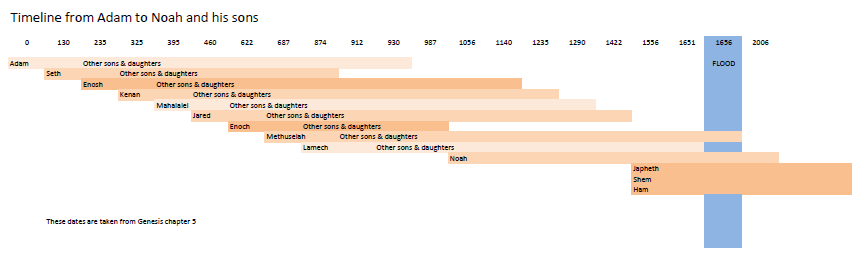
The first question has to be: Did people really live that long?
And the first answer is no-one will ever know!
But we can do better than that. We only ask the question because it is not our normal experience for people to live that long.
People have tried to suggest ways that can cater for these (unusually) long ages: perhaps their years were shorter; perhaps they simply inflated ages to make people look good etc.
But as we have seen before, it is possible to take the Bible as truth. When Humans were created they were perfect, apparently with an anatomical ability to live for ever. Adam’s choice meant that this was denied him, but the uncorrupted genetic makeup of humans meant that they would at least live for (what we would consider to be) a long time.
A very small number of organisms have no genetic age limit and only die through disease or injury. All other organisms are subject to the ‘Hayflick limit’ – a genetic limit to the number of times a cell can replicate itself. Obviously, in humans, our life expectancy is also governed by our lifestyle.
It is interesting that in the time of Noah, God himself reduced the age to which people would live. Genesis 6:3
Then the LORD said, My Spirit will not contend with man for ever, for he is mortal; his days will be a hundred and twenty years.
For the Lord to have to make this decision, it is obvious that before then, people must have lived longer! (At the time of Moses it appears that life expectancy was only 70-80 years Psalm 90:10)
Perhaps the most important thing to notice in this passage is in verses 1 & 3.
Verse 1: When God created man, he made him in the likeness of God.
Verse 3: Adam had a son in his own likeness, in his own image.
Adam was truly unique, and he had amazing potential. We can only dream of what the world would have been like without sin. But when sin entered, Adam lost something of the image of God. What was that?
(Righteousness, holiness, ability to live for ever?)
As a result, we have the sad refrain ‘and then he died’ verses 5, 8, 11, 14, etc. reminding us of the warning to Adam in Genesis 2:17 'you must not eat from the tree of the knowledge of good and evil, for when you eat of it you will surely die.'
In the long lists in chapter 5, there are a few people we ought to note specifically.
In verse 24 Enoch walked with God; then he was no more, because God took him away. In Hebrews 11:5 we read By faith Enoch was taken from this life, so that he did not experience death; he could not be found, because God had taken him away. For before he was taken, he was commended as one who pleased God.
There is no other detail given but it seems that only he and Noah ‘found favour in the eyes of the Lord’ (Genesis 6:8).
Methuselah is well-known for being the person who has lived the longest, 969 years, but he had nothing else to commend him, and he died in the same year as the flood – probably as a result of it.
Noah brought comfort to his parents (v29) as an additional labourer in the family. What was their problem?
They suffered ‘labour and painful toil’
Who did they blame for that? The Lord? or Adam’s sin?
Does the Lord still get blamed for the results of sin?
Another thing of interest is verse 1a this is the written account of Adam's line.
Notice it is the written account.
It used to be thought that much of Genesis was passed on by word of mouth but archaeological discoveries show that writing (cuneiform on clay tablets) has been around at least since the flood! It is also interesting that the word translated 'written' often means 'tablet' or 'scroll'.
It is generally accepted that Moses wrote the book of Genesis on scrolls, but it seems he drew upon sets of ‘family histories’ that had been passed down to him.
The earliest writing was Cuneiform. It was written using a stick shaped to a thin triangle point indented into soft clay which was then baked. It was not originally a specific language. It represented sounds, (phonetic syllabic values) and so could reflect any language!
About ½ million examples of Cuneiform writing have so far been found in Archaeological digs throughout the Middle East. The earliest tablets – 3200-3500BC were found in Uruk, southern Mesopotamia (Iraq).
The clay tablets Moses used would often have had a brief summary, and the name of the author, or owner. As Moses compiled the book of Genesis he may well have added these at the end of each tablet — ‘this is the account of . . . .’ These are visible in Genesis 2:4, 5:1, 6:9, 10:1, 11:10, 11:27, 25:12, 25:19, 36:1, 36:9, 37:2
It has been suggested that when the bible was divided into chapters at the beginning of the 13th century, the summaries should have been included at the end of the passage they relate to, rather than being part of the next chapter.
That is because in each case the details of the family histories couldn’t extend beyond what the named person would have experienced, and finishes before his death – rather like anyone writing a diary today.
For example, Adam recorded his family tree and the events leading up the birth of Shem and his son (5:1), but he couldn’t have written chapter 5 after verse 28 as by then he would have been dead!
So it was probably Noah who recorded chapter 5, including his own birth, and the actual flood and its aftermath (6:9 This is the account of Noah.) His sons wrote the next section (10:1 This is the account of Shem, Ham and Japheth, Noah’s sons). And Shem, who outlived his brothers, added to this later (11:10 This is the account of Shem).
Let's now look at the first few verses of Genesis 6, and immediately we will run into a problem!
We've already read verse 3 so we'll read Genesis 6:1-2&4
1 When men began to increase in number on the earth and daughters were born to them, 2 the sons of God saw that the daughters of men were beautiful, and they married any of them they chose.
3 Then the LORD said, My Spirit will not contend with man for ever, for he is mortal; his days will be a hundred and twenty years.
4 The Nephilim were on the earth in those days— and also afterwards— when the sons of God went to the daughters of men and had children by them. They were the heroes of old, men of renown.
Who were the ‘sons of God …Nephilim … heroes of old, men of renown’ ?
Perhaps a way to approach this question is to ask who they were not?
We know that Jesus was the one and only son of God: John 1:14, John 1:18, John 3:16, John 3:18. So they cannot be sons of God in that sense.
Could they be Angels? No: Angels are spiritual beings (Hebrews 1:14) and Matthew 22:30 At the resurrection people will neither marry nor be given in marriage; they will be like the angels in heaven.
But having said that, we know that Angels can take human form, and have been recorded as eating food (Genesis 19:3).
Could they be Humans?
Let’s look back at chapter 5 verse 3
3 When Adam had lived 130 years, he had a son in his own likeness, in his own image; and he named him Seth.
Here the writer has deliberately ignored Cain and Abel. Abel we know died, but we do know a little more of Cain’s line from chapter 4.
In verses 17 we read that Cain was then building a city and now We will read from chapter 4:19-23
19 Lamech married two women, one named Adah and the other Zillah. 20 Adah gave birth to Jabal; he was the father of those who live in tents and raise livestock. 21 His brother’s name was Jubal; he was the father of all who play the harp and flute. 22 Zillah also had a son, Tubal-Cain, who forged all kinds of tools out of bronze and iron. Tubal-Cain’s sister was Naamah.
23 Lamech said to his wives,
“Adah and Zillah, listen to me; wives of Lamech, hear my words.
I have killed a man for wounding me, a young man for injuring me.
Most commentators draw a distinction between the line of Cain, who turned his back on God, and the line of Seth who was the forerunner of Noah, assuming that it was his line that ‘called on the name of the Lord’ (Genesis 4:26).
Cain and his descendants seem to be ‘different’. Cain himself built a city, Jubal produced skilled musicians, Tubal-Cain was a skilled metal-worker and Lamech was a bigamist and murderer.
Perhaps the sin of pride was also well-entrenched in the family line. If at the same time they were bigger than normal, of great size and strength, they would fit the bill perfectly!
It is suggested that these men would simply take any woman they wanted to satisfy the desires of the flesh. Not the way marriage had been intended. And not only that, but these were reckoned as great men – men of renown – by their peers.
So to raid the descendants of Seth, taking off whatever women they chose, might be the basis for these verses in chapter 6. But also for the writer to describe them in this way would justify the fact that people were scared to resist them.
Whatever the true meaning, these verses were deliberately put before verse 5
Read verse 5
5 The LORD saw how great man's wickedness on the earth had become, and that every inclination of the thoughts of his heart was only evil all the time.
Can someone describe how God felt – seeing what had happened to his perfect creation?
Read verse 6
6 The LORD was grieved that he had made man on the earth, and his heart was filled with pain.
God’s initial reaction (v3) had been to shorten the years of a man’s life, but now the time had come for something more drastic and final.
Read verses 7-8
7 So the LORD said, I will wipe mankind, whom I have created, from the face of the earth— men and animals, and creatures that move along the ground, and birds of the air— for I am grieved that I have made them.
8 But Noah found favour in the eyes of the LORD
Did God know this was going to happen before he created everything?
Later on, did God need to demonstrate to mankind that every other possible alternative had been tried to turn them back to him, (Starting again, giving a full set of rules to live by, choosing a particular nation and offering to specially bless it if they would only honour him), before he finally had to send his Son to die for our salvation?
What is our response to Almighty God who himself has provided the only possible way for our salvation through the death and resurrection of his only son, The Lord Jesus Christ?