Recap:
So far we have looked at the account of creation, Adam and Eve, Adam’s family tree, the reason for the Flood, Noah, and God’s instructions to him to build the Ark, and the flood.
Read Genesis 8:1-22
The previous chapter, chapter 7, was concerned with judgement. But that is all over now, now we are looking at salvation and new beginnings. It is not surprising that many Christians are baptised as a demonstration of their death to sin, entering the water symbolising the burial of the old life, and coming up out of the water, their commitment to walk in newness of life in Christ Jesus.
1 But God remembered Noah and all the wild animals and the livestock that were with him in the ark, and he sent a wind over the earth, and the waters receded.
I wonder if this was just a wind? The word for wind is the same word as Spirit – Look back at Genesis 1:2 and the Spirit of God was hovering over the waters. As we look into chapters 8 and 9 we will see other similarities with this new beginning and the events of Genesis 1.
So, at God’s command the waters began to drain off the land. Interesting, considering everything was under water, where could the waters drain to?
I think that as we have seen, some would form subterranean reserves, but if this was a time of vast upheaval on the Earth, I imagine the raising of continents would also account for the draining off of the overlying water. As the land was forced upwards, the runoff of water over the soft, still mud-like sedimentary rocks would in some places cause deep gorges, in others wide river valleys. Many of the gigantic limestone caves could have been formed in the same way, with vast amounts of water draining through the still soft limestone.
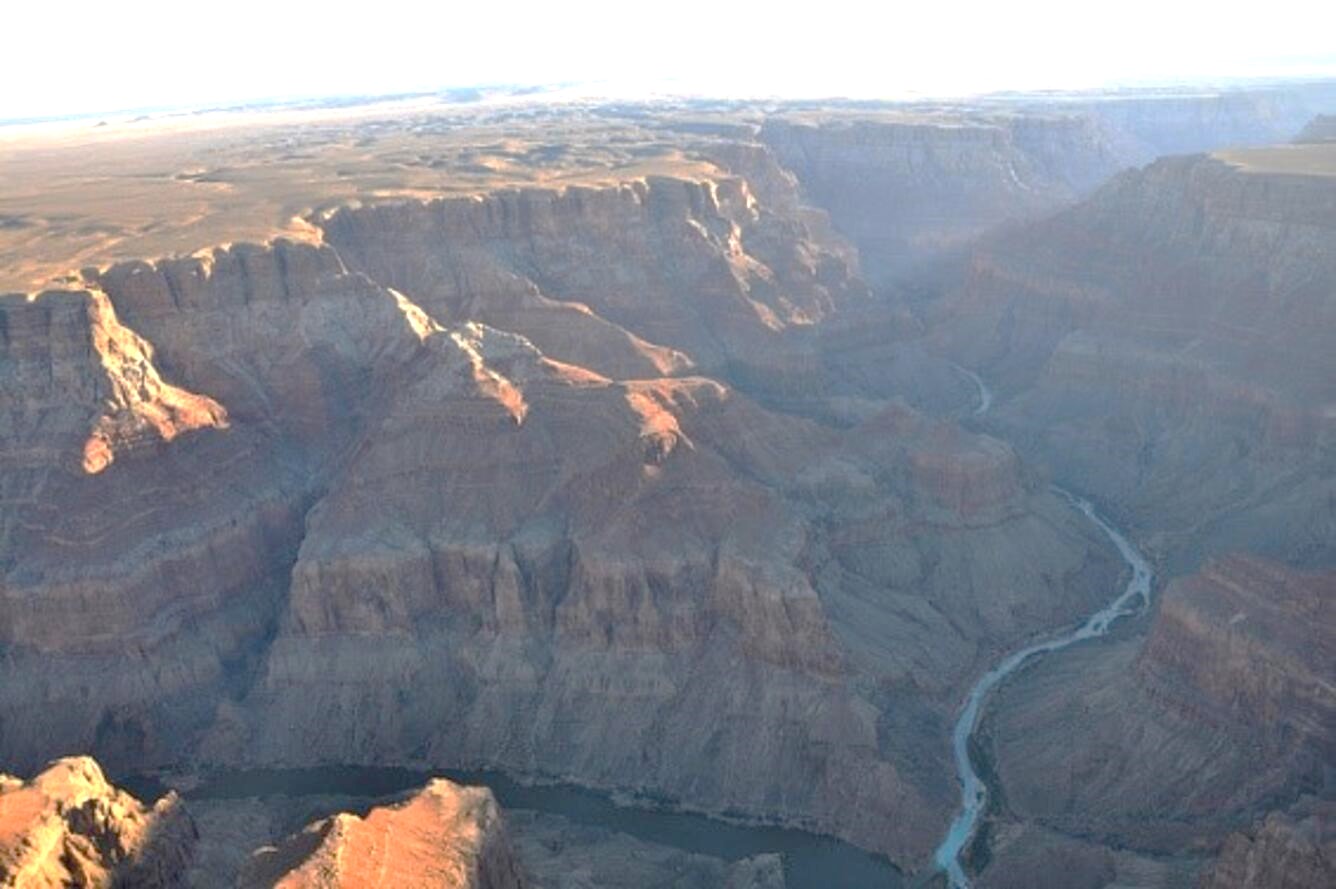
On holiday, I came across a small river flowing out to sea across a wide sandy beach. When the tide was in, strong currents and waves flattened the sand under the flowing river, but it was very soft – like quicksand, and dangerous to walk on!
As the tide retreated, the flowing river and outgoing tide again cut through the wet sand. It made miniature gorges and canyons with small streams at the bottom looking almost exactly like the 'Grand' one pictured (but on a vastly different scale!).
The safest place to be, while the Earth underwent such violent transformation, was actually in an Ark, floating above it!
2 Now the springs of the deep and the floodgates of the heavens had been closed, and the rain had stopped falling from the sky.
3 The water receded steadily from the earth. At the end of the hundred and fifty days the water had gone down, (Five months)
4 and on the seventeenth day of the seventh month the ark came to rest on the mountains of Ararat.
5 The waters continued to recede until the tenth month, and on the first day of the tenth month the tops of the mountains became visible.
(Compare with Genesis 1:9)
The tectonic plates continued to move. Here the Eurasian and Arabian tectonic plates split apart and vast volumes of molten rock from the Earth’s core poured out of the split causing mountains to rise. Ararat is now about 2 ½ miles high, and composed entirely of volcanic lava flows (the last volcanic activity was in 1840). The whole area is considered to contain 280 cubic miles of volcanic material.
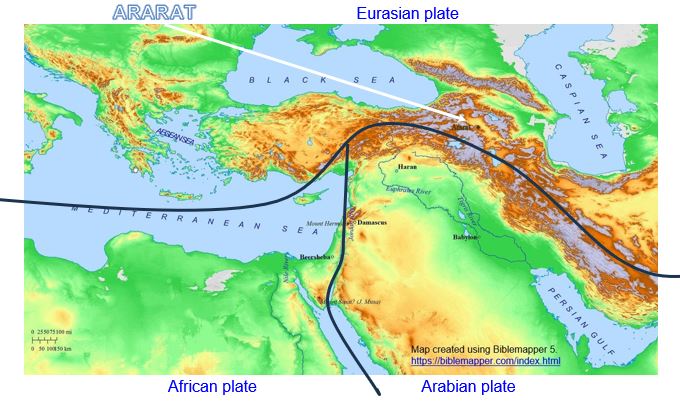
After the rain stopped, it took seven and a half months before the mountain-tops became visible from the Ark. Even draining for such a long time, this would mean that now there was still at least two miles depth of water under the Ark.
6 After forty days Noah opened the window he had made in the ark
7 and sent out a raven, and it kept flying back and forth until the water had dried up from the earth.
(Compare with Genesis 1:20)
That suggests to me that the raven was free to go to and fro, returning to the Ark as the only perch available whenever it needed to rest. It would also have to return for food. But as a carrion eater, once the water had receded it could probably find food for itself.
8 Then he sent out a dove to see if the water had receded from the surface of the ground.
9 But the dove could find no place to set its feet because there was water over all the surface of the earth; so it returned to Noah in the ark. He reached out his hand and took the dove and brought it back to himself in the ark.
Doves are mainly seed or fruit eaters. They also tend to avoid wet or marshy ground! It would probably prefer to return for food until the ground had dried and plants were growing again.
10 He waited seven more days and again sent out the dove from the ark.
11 When the dove returned to him in the evening, there in its beak was a freshly plucked olive leaf! Then Noah knew that the water had receded from the earth.
12 He waited seven more days and sent the dove out again, but this time it did not return to him.
13 By the first day of the first month of Noah's six hundred and first year, the water had dried up from the earth. Noah then removed the covering from the ark and saw that the surface of the ground was dry.
An interesting detail – obviously the small window did not allow a view of the ground that the Ark was resting on – some of the roof had to be removed to get a good look!
14 By the twenty-seventh day of the second month the earth was completely dry.
It took very nearly two months for the sediment left from the flood to become hard enough to walk on after the waters had receded (v13).
It was now one year and ten days after the flood had started (Genesis 7:11) But note that everyone was still on the Ark – no-one had made a move to leave its safety.
Do we sometimes get stuck in a rut and need prompting to step out into something new?
15 Then God said to Noah,
16 Come out of the ark, you and your wife and your sons and their wives.
It might have been very tempting to regard the Ark as a convenient place to call home. It would have made a very spacious block of flats. But Noah and his whole family had been told to come out, and start the new chapter. Having experienced salvation, there was now a new life to live.
17 Bring out every kind of living creature that is with you— the birds, the animals, and all the creatures that move along the ground— so they can multiply on the earth and be fruitful and increase in number upon it.
(Compare with Genesis 1:25)
18 So Noah came out, together with his sons and his wife and his sons' wives.
19 All the animals and all the creatures that move along the ground and all the birds— everything that moves on the earth— came out of the ark, one kind after another.
At last they could venture out, and probably the first animals to leave had to be encouraged by Noah and his family. But after that, I can picture the animals eager to enjoy their freedom after a year’s dormancy.
Obviously the domesticated animals were not free to escape! But the form of nomadic herding they were used to did not require fences or hedges to contain them. Presumably there was new vegetation growing near the Ark and they had no need to wander far.
20 Then Noah built an altar to the LORD and, taking some of all the clean animals and clean birds, he sacrificed burnt offerings on it.
There had been a desire to bring offerings to God as long ago as Cain and Abel – burnt offerings were recognised as the only practical way to do this. And the offering of Noah was found to be pleasing.
21 The LORD smelled the pleasing aroma and said in his heart: Never again will I curse the ground because of man, even though every inclination of his heart is evil from childhood. And never again will I destroy all living creatures, as I have done.
Note the phrase every inclination of his heart is evil from childhood
And compare it with Genesis 6:5 every inclination of the thoughts of the human heart was only evil all the time.
God recognised that even though mankind had been given a fresh start, it was a fact that because of (Adam's) sin, the human heart would still be corrupt from childhood.
Think about it – you don’t have to teach a child how to be naughty.
Even so he promises that he will never again – what?
curse the ground . . . . destroy all living creatures.
This will be confirmed to Noah in a covenant (next chapter)
What else does he promise?
22 As long as the earth endures, seedtime and harvest,
cold and heat, summer and winter, day and night will never cease.
For just over a year, the seasons had been interrupted. Now God’s promise is that they will be restored and while life remains on the Earth, food will also be provided. Why then do we see hunger and starvation in many parts of the World?