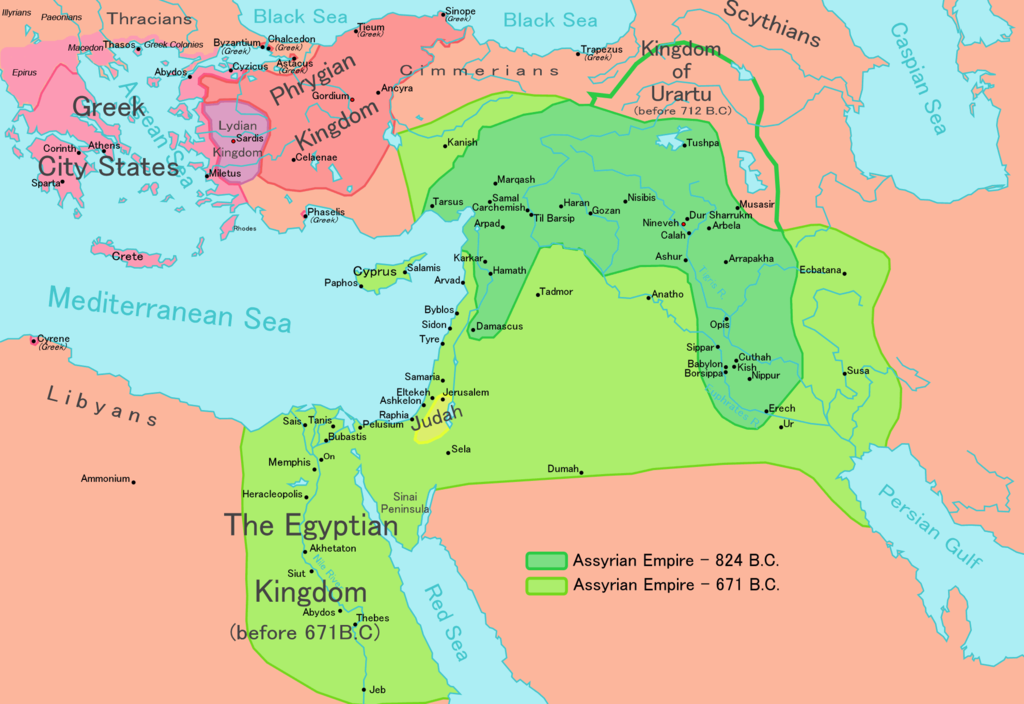
Having prophesied concerning the fall of Assyria, Isaiah now goes back and records a historical section showing how the Lord actually fulfilled the words of his prophecy. This and the following chapters are almost a mirror image of 2 Kings chapters 18-20 but there is sometimes more information there. I commented there, but to be consistent I am commenting again here.
(If you would like some more background see the study in 2 Kings 17 & 18)
Following the disastrous reign of King Ahaz of Judah (in the south), Hezekiah, then aged 25, became King. Ahaz had encouraged all manner of Idol worship, including the worship of Baal and Asherah. But now as a complete contrast, we are told in 2 Kings 18:5-6 that ‘Hezekiah trusted in the Lord, the God of Israel. There was no one like him among all the kings of Judah, either before him or after him. 6 He held fast to the Lord and did not stop following him; he kept the commands the Lord had given Moses’.
He immediately set out on a campaign that would return the people to the worship of the one true God. He removed the high places, smashed the sacred stones and cut down the Asherah poles. He broke into pieces the bronze snake Moses had made, for up to that time the Israelites had been burning incense to it. (It was called Nehushtan.) (2 Kings 18:4)
Meanwhile the Assyrians had attacked and taken Israel (in the north) and deported its population, replacing them with people from other lands that they had conquered.
Now they turned their attention to Judah (in the south).
Isaiah himself lived through these times and was deeply involved, as we will see. So lets go back in Isaiah's diary to the period following the death of King Ahaz of Judah.
Isaiah 36
Read verse 1
1 In the fourteenth year of King Hezekiah’s reign, Sennacherib king of Assyria attacked all the fortified cities of Judah and captured them.
2 Kings 18:13-16 says
13 In the fourteenth year of King Hezekiah’s reign, Sennacherib king of Assyria attacked all the fortified cities of Judah and captured them. 14 So Hezekiah king of Judah sent this message to the king of Assyria at Lachish: ‘I have done wrong. Withdraw from me, and I will pay whatever you demand of me.’ The king of Assyria exacted from Hezekiah king of Judah three hundred talents of silver and thirty talents of gold. 15 So Hezekiah gave him all the silver that was found in the temple of the Lord and in the treasuries of the royal palace.
16 At this time Hezekiah king of Judah stripped off the gold with which he had covered the doors and doorposts of the temple of the Lord, and gave it to the king of Assyria.
That bought him some time so he then paid attention to repairing the walls and providing weapons ready for another attack. He didn’t have to wait long.
Read verses 2-3
2 Then the king of Assyria sent his field commander with a large army from Lachish to King Hezekiah at Jerusalem. When the commander stopped at the aqueduct of the Upper Pool, on the road to the Launderer’s Field, 3 Eliakim son of Hilkiah the palace administrator, Shebna the secretary, and Joah son of Asaph the recorder went out to him.
Diplomatically, when you are told a foreign army is now on its way to take over your nation, you first try to talk. Besides, Hezekiah knew he was in trouble, he had no more money left to buy them off again.
Read 4-7
4 The field commander said to them, ‘Tell Hezekiah:
‘“This is what the great king, the king of Assyria, says: on what are you basing this confidence of yours? 5 You say you have counsel and might for war – but you speak only empty words. On whom are you depending, that you rebel against me? 6 Look, I know you are depending on Egypt, that splintered reed of a staff, which pierces the hand of anyone who leans on it! Such is Pharaoh king of Egypt to all who depend on him. 7 But if you say to me, ‘We are depending on the Lord our God’– isn’t he the one whose high places and altars Hezekiah removed, saying to Judah and Jerusalem, ‘You must worship before this altar’?
For people who saw no difference between the many gods that were worshipped, it seemed a very strange thing to break down altars to one god, and then trust another god to protect you. And by then everyone knew you couldn’t trust Egypt to come to your rescue.
Read 8-22 (a long passage – encourage people to share)
8 ‘“Come now, make a bargain with my master, the king of Assyria: I will give you two thousand horses – if you can put riders on them! 9 How then can you repulse one officer of the least of my master’s officials, even though you are depending on Egypt for chariots and horsemen? 10 Furthermore, have I come to attack and destroy this land without the Lord? The Lord himself told me to march against this country and destroy it.”‘
11 Then Eliakim, Shebna and Joah said to the field commander, ‘Please speak to your servants in Aramaic, since we understand it. Don’t speak to us in Hebrew in the hearing of the people on the wall.’
12 But the commander replied, ‘Was it only to your master and you that my master sent me to say these things, and not to the people sitting on the wall – who, like you, will have to eat their own excrement and drink their own urine?’
13 Then the commander stood and called out in Hebrew, ‘Hear the words of the great king, the king of Assyria! 14 This is what the king says: do not let Hezekiah deceive you. He cannot deliver you! 15 Do not let Hezekiah persuade you to trust in the Lord when he says, “The Lord will surely deliver us; this city will not be given into the hand of the king of Assyria.”
16 ‘Do not listen to Hezekiah. This is what the king of Assyria says: make peace with me and come out to me. Then each of you will eat fruit from your own vine and fig-tree and drink water from your own cistern, 17 until I come and take you to a land like your own – a land of corn and new wine, a land of bread and vineyards.
18 ‘Do not let Hezekiah mislead you when he says, “The Lord will deliver us.” Have the gods of any nations ever delivered their lands from the hand of the king of Assyria? 19 Where are the gods of Hamath and Arpad? Where are the gods of Sepharvaim? Have they rescued Samaria from my hand? 20 Who of all the gods of these countries have been able to save their lands from me? How then can the Lord deliver Jerusalem from my hand?’
21 But the people remained silent and said nothing in reply, because the king had commanded, ‘Do not answer him.’
22 Then Eliakim son of Hilkiah the palace administrator, Shebna the secretary and Joah son of Asaph the recorder went to Hezekiah, with their clothes torn, and told him what the field commander had said.
King Hezekiah was faced with a truly daunting choice. Yes it was true, he now had no gold or silver left, and Assyria could easily destroy them. Yes it was true that no other nation’s gods had ever withstood the might of Assyria, but – could he now really trust the Lord for deliverance? His first act was simply to ask Isaiah to pray.
Isaiah 37
Read 1-4
1 When King Hezekiah heard this, he tore his clothes and put on sackcloth and went into the temple of the Lord. 2 He sent Eliakim the palace administrator, Shebna the secretary, and the leading priests, all wearing sackcloth, to the prophet Isaiah son of Amoz. 3 They told him, ‘This is what Hezekiah says: this day is a day of distress and rebuke and disgrace, as when children come to the moment of birth and there is no strength to deliver them. 4 It may be that the Lord your God will hear the words of the field commander, whom his master, the king of Assyria, has sent to ridicule the living God, and that he will rebuke him for the words the Lord your God has heard. Therefore pray for the remnant that still survives.’
Isaiah received his call ‘in the year that king Uzziah died’. He had been faithfully prophesying since, to what had been a wicked and idolatrous nation. Hezekiah knew he could be relied on.
5 When King Hezekiah’s officials came to Isaiah, 6 Isaiah said to them, ‘Tell your master, “This is what the Lord says: do not be afraid of what you have heard – those words with which the underlings of the king of Assyria have blasphemed me. 7 Listen! When he hears a certain report, I will make him want to return to his own country, and there I will have him cut down with the sword.”‘
It seems that God answered even before Isaiah prayed!. Don’t worry, he said, not only will Sennacherib simply go away, but he will actually be assassinated!
Read 8
8 When the field commander heard that the king of Assyria had left Lachish, he withdrew and found the king fighting against Libnah.
While all this had been going on, Sennacherib and his main army had been fighting at Lachish. Obviously as the Field Commander, he felt he needed to go to join forces with his king who having subdued Lachish, was now fighting at Libnah. (Lachish was a powerful city near the border of Judah, near Philistine country). However it seemed that the skirmish over Libnah was short lived and Sennacherib soon returned to Jerusalem.
Read 9-13
9 Now Sennacherib received a report that Tirhakah, the king of Cush, was marching out to fight against him. When he heard it, he sent messengers to Hezekiah with this word: 10 ‘Say to Hezekiah king of Judah: do not let the god you depend on deceive you when he says, “Jerusalem will not be given into the hands of the king of Assyria.” 11 Surely you have heard what the kings of Assyria have done to all the countries, destroying them completely. And will you be delivered? 12 Did the gods of the nations that were destroyed by my predecessors deliver them – the gods of Gozan, Harran, Rezeph and the people of Eden who were in Tel Assar? 13 Where is the king of Hamath or the king of Arpad? Where are the kings of Lair, Sepharvaim, Hena and Ivvah?’
Sennacherib was concerned. He had committed his whole army to fighting in this obscure corner of his empire, leaving his main centres of Nineveh and Babylon unguarded. Which way will the Egyptians come, round the coast, or inland – the other side of the Jordan? Perhaps by simply issuing more threats Hezekiah might surrender and he could return home quickly.
14 Hezekiah received the letter from the messengers and read it. Then he went up to the temple of the Lord and spread it out before the Lord. 15 And Hezekiah prayed to the Lord: 16 ‘Lord Almighty, the God of Israel, enthroned between the cherubim, you alone are God over all the kingdoms of the earth. You have made heaven and earth. 17 Give ear, Lord, and hear; open your eyes, Lord, and see; listen to all the words Sennacherib has sent to ridicule the living God.
18 ‘It is true, Lord, that the Assyrian kings have laid waste all these peoples and their lands. 19 They have thrown their gods into the fire and destroyed them, for they were not gods but only wood and stone, fashioned by human hands. 20 Now, Lord our God, deliver us from his hand, so that all the kingdoms of the earth may know that you, Lord, are the only God.’
Hezekiah had done all he could. Now he simply prayed that God himself would defend his own holy name against the ridicule of Sennacherib.
God heard, and immediately prompted Isaiah to send his reply to Hezekiah!
Read 21-38 (another long passage – encourage people to share)
21 Then Isaiah son of Amoz sent a message to Hezekiah: ‘This is what the Lord, the God of Israel, says: because you have prayed to me concerning Sennacherib king of Assyria, 22 this is the word the Lord has spoken against him:
‘Virgin Daughter Zion despises and mocks you. Daughter Jerusalem tosses her head as you flee.
23 Who is it you have ridiculed and blasphemed? Against whom have you raised your voice and lifted your eyes in pride? Against the Holy One of Israel!
24 By your messengers you have ridiculed the Lord. And you have said, “With my many chariots I have ascended the heights of the mountains, the utmost heights of Lebanon. I have cut down its tallest cedars, the choicest of its junipers. I have reached its remotest heights, the finest of its forests.
25 I have dug wells in foreign lands and drunk the water there. With the soles of my feet I have dried up all the streams of Egypt.”
26 ‘Have you not heard? Long ago I ordained it. In days of old I planned it; now I have brought it to pass, that you have turned fortified cities into piles of stone.
27 Their people, drained of power, are dismayed and put to shame. They are like plants in the field, like tender green shoots, like grass sprouting on the roof, scorched before it grows up.
28 ‘But I know where you are and when you come and go and how you rage against me. 29 Because you rage against me and because your insolence has reached my ears, I will put my hook in your nose and my bit in your mouth, and I will make you return by the way you came.
30 ‘This will be the sign for you, Hezekiah: ‘This year you will eat what grows by itself, and the second year what springs from that. But in the third year sow and reap, plant vineyards and eat their fruit.
31 Once more a remnant of the kingdom of Judah will take root below and bear fruit above. 32 For out of Jerusalem will come a remnant, and out of Mount Zion a band of survivors. The zeal of the Lord Almighty will accomplish this.
33 ‘Therefore this is what the Lord says concerning the king of Assyria:
‘He will not enter this city or shoot an arrow here.
He will not come before it with shield or build a siege ramp against it.
34 By the way that he came he will return; he will not enter this city,’ declares the Lord.
35 ‘I will defend this city and save it, for my sake and for the sake of David my servant!’
36 Then the angel of the Lord went out and put to death a hundred and eighty-five thousand in the Assyrian camp. When the people got up the next morning – there were all the dead bodies! 37 So Sennacherib king of Assyria broke camp and withdrew. He returned to Nineveh and stayed there.
38 One day, while he was worshipping in the temple of his god Nisrok, his sons Adrammelek and Sharezer killed him with the sword, and they escaped to the land of Ararat. And Esarhaddon his son succeeded him as king.
That was enough for Sennacherib. But God would not be mocked. Look back at verses 28-29. He quickly withdrew back to his capital city. Even though God had destroyed his army at a stroke, he still refused to accept the sovereignty of God.
To then go to deliberately worship a heathen god (verse 38) sealed his fate.
A few years later, in 671BC Esarhaddon conquered Egypt, thus making him ruler over the largest empire there had ever been.