(This will be a short study)
Following the withdrawal of the armies of Assyria, and the death of their king Sennacherib, Hezekiah had settled to a life of peace. But it was not to last.
Read Isaiah 38:1
1 In those days Hezekiah became ill and was at the point of death. The prophet Isaiah son of Amoz went to him and said, “This is what the Lord says: Put your house in order, because you are going to die; you will not recover.”
Death comes to us all, but very graciously, the Lord sent his prophet Isaiah to warn Hezekiah. Naturally, he was a bit upset!
2 Hezekiah turned his face to the wall and prayed to the Lord, 3 “Remember, Lord, how I have walked before you faithfully and with wholehearted devotion and have done what is good in your eyes.” And Hezekiah wept bitterly.
Well, Hezekiah did have a point, he had actually been the best king (after David) that had ever ruled Judah.
4 Then the word of the Lord came to Isaiah: 5 “Go and tell Hezekiah, ‘This is what the Lord, the God of your father David, says: I have heard your prayer and seen your tears; I will add fifteen years to your life. 6 And I will deliver you and this city from the hand of the king of Assyria. I will defend this city.
Wow! I find that amazing. Not only will he give Hezekiah fifteen more years, but they will be peaceful, with no more attacks.
Now we have to read two verses which seems quite out of order, it’s verses 21 and 22. (They seem to have been added at the bottom of the page in the same way that today we would add a footnote.)
Hezekiah was thrilled for his reprieve, but he was still ill and was at the point of death (verse 1)
21 Isaiah had said, “Prepare a poultice of figs and apply it to the boil, and he will recover.”
I doubt it was an ordinary boil as we would describe it today, perhaps a tumour, but certainly it was life-threatening. And figs themselves would not be the cure, it had to be the Lord’s doing.
22 Hezekiah had asked, “What will be the sign that I will go up to the temple of the Lord?”
Quite naturally, Hezekiah still could not really believe that all this would be granted to him. So he asked Isaiah if there would be some sort of sign – but also note that his main concern was that he would again be able to worship at the Temple.
Now we can return to our passage. Verse 7
7 “‘This is the Lord’s sign to you that the Lord will do what he has promised: 8 I will make the shadow cast by the sun go back the ten steps it has gone down on the stairway of Ahaz.’” So the sunlight went back the ten steps it had gone down.
If Hezekiah’s healing was a miracle, the sign God sent was a super-miracle!
And no, no-one has come up with a suitable explanation! We are simply left to marvel at the kindness of God to allow it.
Hezekiah himself was moved to write a song of praise. Perhaps you could read all verses 9-20 before commenting.
9 A writing of Hezekiah king of Judah after his illness and recovery:
10 I said, “In the prime of my life must I go through the gates of death and be robbed of the rest of my years?” 11 I said, “I will not again see the Lord himself in the land of the living; no longer will I look on my fellow man, or be with those who now dwell in this world. 12 Like a shepherd’s tent my house has been pulled down and taken from me. Like a weaver I have rolled up my life, and he has cut me off from the loom; day and night you made an end of me.
What wonderful pictures. A shepherds tent was an uncomplicated structure, designed to be taken down very quickly.
And once the cloth had been cut from the threads on the loom, it was completed. No more threads could be added, that was the end. But Hezekiah still had faith:
13 I waited patiently till dawn, but like a lion he broke all my bones; day and night you made an end of me. 14 I cried like a swift or thrush, I moaned like a mourning dove. My eyes grew weak as I looked to the heavens. I am being threatened; Lord, come to my aid!” 15 But what can I say? He has spoken to me, and he himself has done this. I will walk humbly all my years because of this anguish of my soul.
We were told that Hezekiah was so ill he was at the point of death. Even so he waited patiently, praying for the Lord to come to his aid.
16 Lord, by such things people live; and my spirit finds life in them too. You restored me to health and let me live. 17 Surely it was for my benefit that I suffered such anguish. In your love you kept me from the pit of destruction; you have put all my sins behind your back. 18 For the grave cannot praise you, death cannot sing your praise; those who go down to the pit cannot hope for your faithfulness.
19 The living, the living—they praise you, as I am doing today; parents tell their children about your faithfulness.
20 The Lord will save me, and we will sing with stringed instruments
all the days of our lives in the temple of the Lord.
Now Hezekiah can praise the lord for his salvation. Not only from his illness, but he was shown that the Lord had forgiven his sins too.
That was Hezekiah’s high point. Unfortunately from there, there is only one direction, and the next chapter starts with a ‘but’.
However, before we read on, we need to look at the heading for the next chapter in the NIV – ‘Envoys From Babylon’
Lets read 2 Chronicles 32:31
31 But when envoys were sent by the rulers of Babylon to ask him about the miraculous sign that had occurred in the land, God left him to test him and to know everything that was in his heart.
News of the healing and God’s sign travelled fast and Marduk-Baladan heard about it. (He had briefly seized the throne in Babylon in the turmoil following the death of Sennacherib.)
The 2 Chronicles passage says that God tested Hezekiah; he knows the human heart only too well as we will see.
Isaiah 39
1 At that time Marduk-Baladan son of Baladan king of Babylon sent Hezekiah letters and a gift, because he had heard of his illness and recovery. 2 Hezekiah received the envoys gladly and showed them what was in his storehouses—the silver, the gold, the spices, the fine olive oil—his entire armoury and everything found among his treasures. There was nothing in his palace or in all his kingdom that Hezekiah did not show them.
Imagine if you were king. Picture a caravan of camels with Envoys of a distant power, dressed in their finest robes, bringing exotic gifts, and letters from their king. Wouldn’t you receive them gladly?
And then, wouldn’t you want to show off all the splendours of your own country?
Was that a good idea?
3 Then Isaiah the prophet went to King Hezekiah and asked, “What did those men say, and where did they come from?”
“From a distant land,” Hezekiah replied. “They came to me from Babylon.”
Of course, we know all about Babylon as a world power greater than the Assyrians, but at that time in Jerusalem it was only a name of some far-off place that few had even heard of.
God needs to have words with Hezekiah.
4 The prophet asked, “What did they see in your palace?”
“They saw everything in my palace,” Hezekiah said. “There is nothing among my treasures that I did not show them.”
5 Then Isaiah said to Hezekiah, “Hear the word of the Lord Almighty: 6 The time will surely come when everything in your palace, and all that your predecessors have stored up until this day, will be carried off to Babylon. Nothing will be left, says the Lord. 7 And some of your descendants, your own flesh and blood who will be born to you, will be taken away, and they will become eunuchs in the palace of the king of Babylon.”
Oh.
How would you react to that revelation?
8 “The word of the Lord you have spoken is good,” Hezekiah replied. For he thought, “There will be peace and security in my lifetime.”
There are a couple of clues here about the way Hezekiah reacted. First he displayed all HIS treasures, when actually they were all that your predecessors have stored up until this day, and his reaction is then ‘Well at least I’ll be alright’.
What can I say? ‘How are the mighty fallen’? It’s sad that Hezekiah was only human, and it is a warning to us too, that however close to the Lord we feel, whatever we have achieved in our Christian walk, we must constantly remember: ‘ So, if you think you are standing firm, be careful that you don’t fall!’ (1 Corinthians 10:12)
What happened next? Well obviously eventually Hezekiah died, and his son Manasseh came to the throne.
Again we will look at 2 Kings:
Read 2 Kings 21:1
1 Manasseh was twelve years old when he became king, and he reigned in Jerusalem for fifty-five years. His mother’s name was Hephzibah.
Hephzibah means ‘In her is my delight’ and she had her baby three years into Hezekiah’s final fifteen year life extension. What a joy this child must have been.
He was only twelve when he came to the throne.
Read 2 Kings 21:2-6
2 He did evil in the eyes of the Lord, following the detestable practices of the nations the Lord had driven out before the Israelites. 3 He rebuilt the high places his father Hezekiah had destroyed; he also erected altars to Baal and made an Asherah pole, as Ahab king of Israel had done. He bowed down to all the starry hosts and worshipped them. 4 He built altars in the temple of the Lord, of which the Lord had said, ‘In Jerusalem I will put my Name.’ 5 In the two courts of the temple of the Lord, he built altars to all the starry hosts. 6 He sacrificed his own son in the fire, practised divination, sought omens, and consulted mediums and spiritists. He did much evil in the eyes of the Lord, arousing his anger.
As we have seen so often before, without a personal faith people will always do what is right in their own eyes (Judges 17:6). Here we have a teenager given immense wealth and power, who turned against a religion that required him to keep rules of holiness, purity and submission. Instead he eagerly followed the worldly pleasures provided by the gods that Ahab and Jezebel had introduced. But there will always be consequences, look at the end of the last verse again.
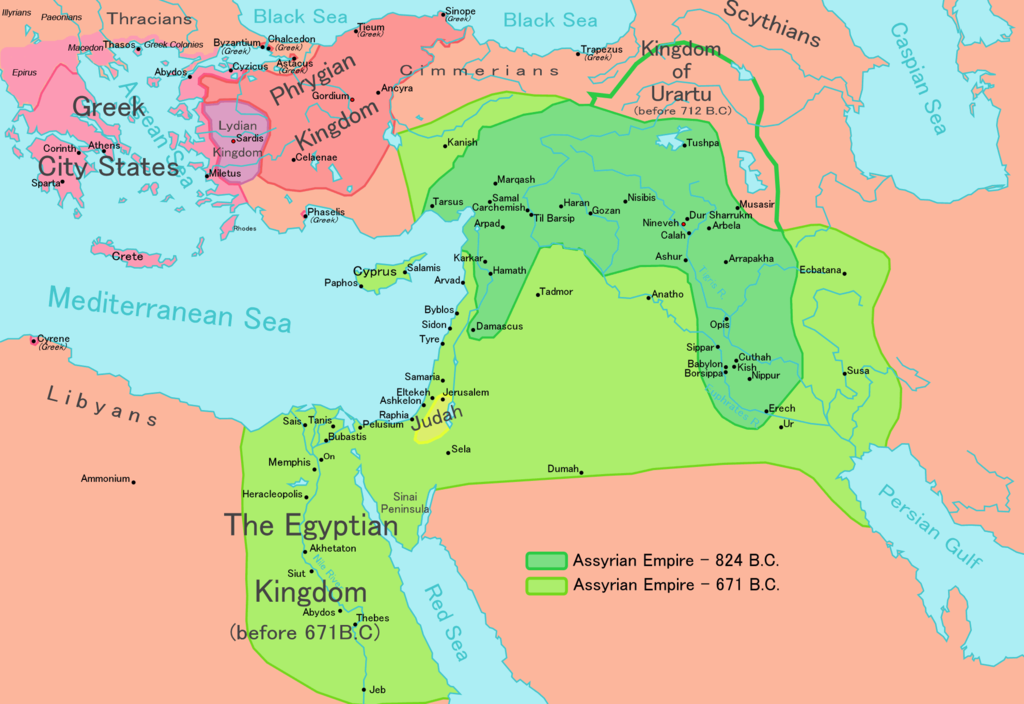
Meanwhile, in Mesopotamia there have been changes. For the last hundred years, a major part of the Assyrian empire had included Babylonia, but they had begun to revolt against Assyrian domination. To quell this, Sennacherib had completely destroyed their capital, Babylon.
Esarhaddon rebuilt it, and before his death he appointed his two sons to succeed him, one in Assyria, and the other in Babylon.
Not a good idea – in 652BC Babylon again rebelled while Assyria was struggling with many internal problems.
By 609BC Babylonian and Median armies had together managed to destroy Assyria. Babylonia was now completely independent and their king Nebuchadnezzar now headed the new super-power.
There was one small part of his entire empire that had not yet been conquered:
Judah.