Recap:
So far we have looked at the account of creation, Adam and Eve, Adam’s family tree, the reason for the Flood, Noah, the flood, God’s covenant and the blessing and cursing of Noah’s sons.
We are about to embark on a brief biblical history and geography of the world. We know that there is no point in going back before Noah as only he and his family survived the flood, and the geography of the world was dramatically altered too. When all the sedimentary rocks were laid down as a result of the scouring action of the Flood, the existing features of the Old World would have been erased.
Another thing to remember is that chapters 10 and 11 cover several hundreds of years.
One problem we may encounter is that Historians and Geographers love to use different names interchangeably, seemingly to deliberately confuse us. I’ll probably do the same but I’ll try to explain as I go along and point it out on the map. Also different countries have different names for other countries: the country that the Polish call Niemcy, and the French call Allemagne, and which I call Germany, is actually Deutschland.
Where shall we start our Geography lesson?
Genesis 8:3-5
3 The water receded steadily from the earth. At the end of the hundred and fifty days the water had gone down, 4 and on the seventeenth day of the seventh month the ark came to rest on the mountains of Ararat. 5 The waters continued to recede until the tenth month, and on the first day of the tenth month the tops of the mountains became visible.
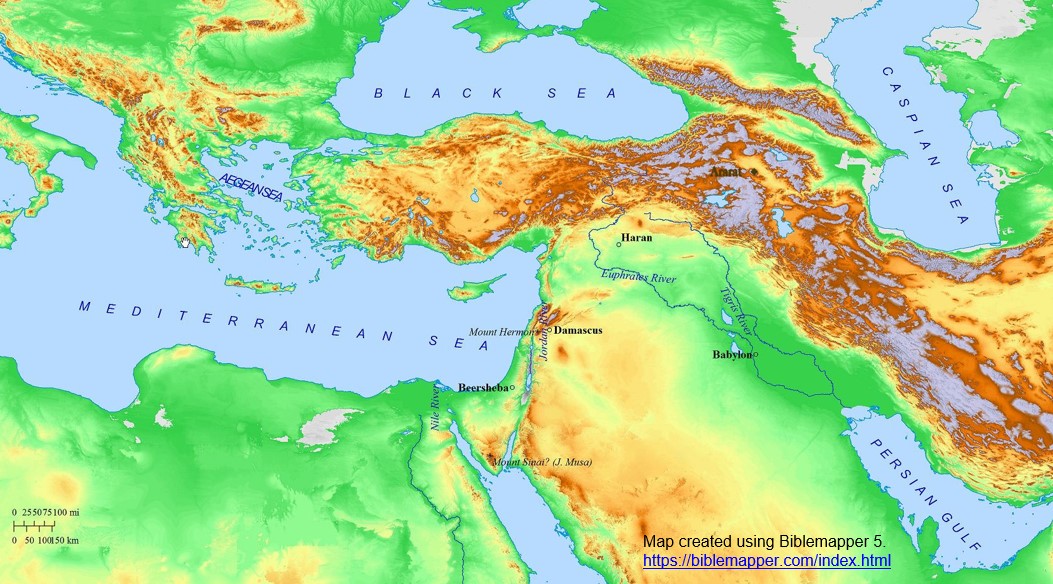 Map002 Mt Ararat
That’s where Noah and his family started so that’s where we will start. What was the mountain? Ararat
No, sorry – it’s actually Buyukagri Dagi or Aghri gadh, or Koh I Noh but I shall still call it Ararat. It’s right in the furthest Eastern end of Turkey near the borders of Armenia, Azerbaijan and Iran. (Point to map)
Remember that this is a map of part of the world as it is today. It would have been dramatically different immediately after the flood.
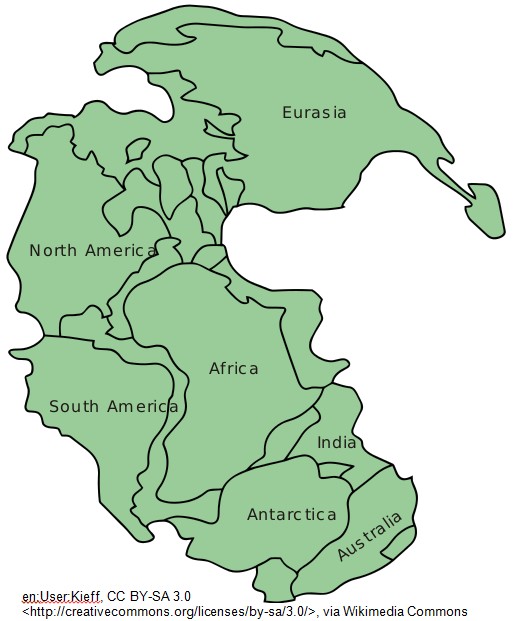
Even during the flood, the Continents had actually moved around a lot, but after the flood it is thought they formed a single land mass – Pangea. Then this too broke up to give us our current continents, and they are still moving - but much slower now.
Pangea (Map001)
Now let’s go back in time. Historians and Geographers like to refer to the area containing modern-day Turkey, as Anatolia. And the parts of Iraq we are interested in are generally referred to as Mesopotamia. But before all this, before anywhere had been discovered and named, we are going to follow Noah and his family.
OK – here they are, perched up a mountain. Near streams which will become tributaries of the mighty Tigris and Euphrates Rivers. They come out of the Ark, let the animals go, what are they most likely to do next?
(Find somewhere to live – warmth, shelter, drinking water, grass or wild cereals, somewhere to plant crops etc )
To find these they would have had to come down out of the highest point of the mountain (which today is 5000 meters or 15,000 feet). And they would probably have naturally chosen the south side, towards the sun. Two thirds of the way down, at 6000 feet, there is a fertile plateau, currently producing wheat and barley, and grape vines are indigenous. But actually it seems that they followed the mountain streams and continued down the Tigris or Euphrates seeking more fertile land (and warmer temperatures!).
How long did the family stay together before the sons moved away? We don’t know. If the family stayed together until Noah died we’re looking at 350 years (Genesis 9 v 28) We know the sons stayed at least long enough to have children and for Noah to plant a vineyard and drink the results.
Chapter 10 will have to wait – we are actually going to start our study in chapter 11, but just verses 1-9.
1 Now the whole world had one language and a common speech.
How long had that language been in existence? (Since Adam & Eve were given language by God?)
2 As people moved eastward they found a plain in Shinar and settled there.
Shinar was the old name for Babylonia – the plain stretching from Babylon to the coast at Ur, between Akkad, Sumer and Elam (Map003). This is an Enlargement taken from Map002 and shows the area in more detail.
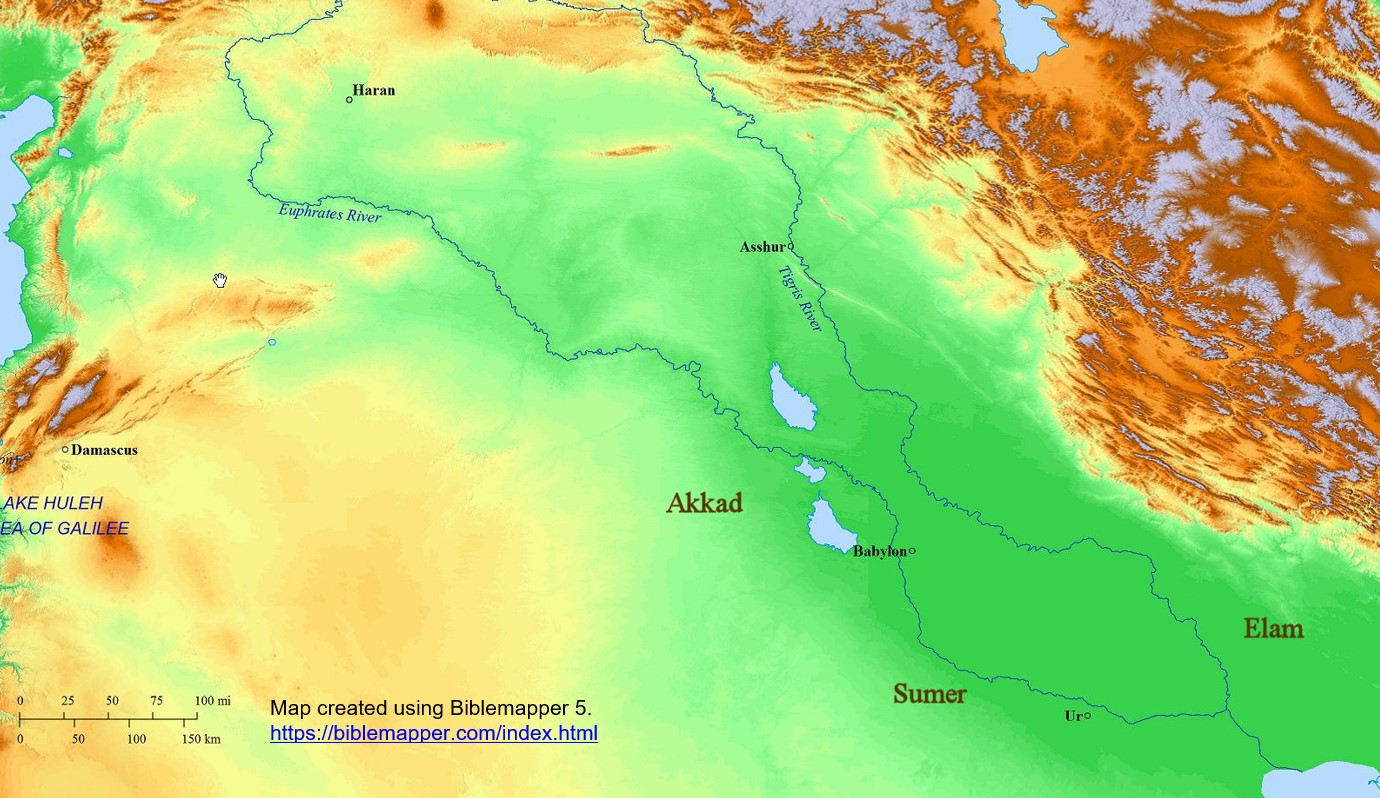 Map003 Babylon
3 They said to each other, ‘Come, let’s make bricks and bake them thoroughly.’ They used brick instead of stone, and bitumen for mortar. 4 Then they said, ‘Come, let us build ourselves a city, with a tower that reaches to the heavens, so that we may make a name for ourselves; otherwise we will be scattered over the face of the whole earth.’
(There was no easily available stone for building, or limestone to make cement).
(You might like to display some key words from the next answers.)
What need do you think prompted the desire in verse 4? Why did they want to ‘build ourselves a city’? A need for security, permanence, a demonstration of power?
‘with a tower that reaches to the heavens’? Independence. Or to demonstrate to God how clever they were: Genesis 3:4 you will be like God. Or a practical purpose – to help you find your way home, or a flood protection – built on a flood plain between two major rivers.
‘make a name for ourselves’? Desire for power, glory, superiority.
‘otherwise we will be scattered’? A desire to stay together (Actually directly opposed to God’s instructions to ‘fill the earth’ Genesis 1:28). But also probably a desire to control, to rule.
Who do you think ‘they’ were:4 Then they said ? Chiefs? Family heads? Rulers?
Why did this draw God’s attention (v5) and cause him to take action (v7)?
Pride, and a demonstration of all they could do without God’s help.
The people were so proud of their city and tower; so immense – a demonstration of their great power and skill.
5 But the Lord came down to see the city and the tower the people were building.
God never acts thoughtlessly, he saw for himself what the people were up to and rather than destroying the tower, went straight for the root of the problem.
Man had found that by working together they could achieve much more than if they worked alone. But this also meant that they thought they could do without their creator.
Look again at the last phrase in verse 4 'we will be scattered over the face of the whole earth'. Wasn't that what God had told man to do four times already? It doesn't pay to be disobedient.
6 The Lord said, ‘If as one people speaking the same language they have begun to do this, then nothing they plan to do will be impossible for them. 7 Come, let us go down and confuse their language so they will not understand each other.’
8 So the Lord scattered them from there over all the earth, and they stopped building the city. 9 That is why it was called Babel – because there the Lord confused the language of the whole world. From there the Lord scattered them over the face of the whole earth.
10 This is the account of Shem.
Where language itself originated is still considered by scientists to be an insoluble problem. Where totally different languages came from is an even bigger problem.
What a brilliant solution! What was the effect of a family group finding that they now spoke a totally different language to their next-door neighbours? (Reminiscent of Acts 2:4-12)
Actually it had a devastating effect on their building plans. It also caused the different groups to now want to distance themselves from the ‘foreigners’ they could no longer understand, and actually start to disperse across the world.
Now we are going back to chapter 10
But before we look at chapter 10 in detail, look at verse 25:
Two sons were born to Eber:
One was named Peleg, because in his time the earth was divided; his brother was named Joktan.
What does the phrase ‘the earth was divided’ mean?
Was it (as the NLT has it) when languages divided people? Or did it refer to the time when Pangea finally broke apart into the separate continental plates? Or both?
Long-age scientists require millions of years for these events to occur, but a major, sudden break-up of what would become the continental shelves is quite within Creator God’s powers.
Now we are about to read Genesis 10. ‘Oh no! All those names! I am bound to get the pronunciation wrong’!
Don’t worry. Spoken Hebrew was lost as a language following the Babylonian exile and was only revived in the last hundred or so years. So no-one can be absolutely sure if one pronunciation is ‘right’ or not. I suggest that you carefully look at the spelling, try a few different pronunciations, settle on one you are comfortable with, and go for it. (There will always be others who will ‘help’ you if they think you are wrong!)
But it is important not to shy away from the names themselves, or from passages in the Bible that seem to contain too many. They are there for a reason and it’s our job to find out what that is.
Before we look at our passage, we need to think about some of the names we will encounter. think about Moab - is Moab the name of a person? Or a people? Or a place? And where is it? And is it important anyway?
The simple answer is that a prominent person will give his name to his family, then his tribe. The area where his tribe settles will be referred to by that name. Villages, towns, cities, even countries will simply follow that pattern. In a world where nothing has a name, these family names are all they have! Until, of course, someone stronger takes over and the town or country is renamed.
Genesis 10:1-32
1 This is the account of Shem, Ham and Japheth, Noah’s sons, who themselves had sons after the flood.
Remember from earlier (Genesis chapter 5) that this phrase could have been the title of the clay tablet written (or owned) by Shem, Ham and Japheth. What follows would then have been copied from the next tablet, written by Shem (Genesis 11:10).
2 The sons of Japheth: Gomer, Magog, Madai, Javan, Tubal, Meshech and Tiras.
3 The sons of Gomer: Ashkenaz, Riphath and Togarmah.
4 The sons of Javan: Elishah, Tarshish, the Kittim and the Rodanim.
5 (From these the maritime peoples spread out into their territories by their clans within their nations, each with its own language.)
It may well be that Moses added verse 5, the note in verse 13, and the explanation of the Canaanite expansion in verses 17 to 19 as he copied Shem’s tablet (Genesis 11:10) as Shem obviously wouldn’t have known what happened later.
We too can add that 'Kittim' in verse 4 is Cyprus today.
Only two of Japheth’s children have their children listed. Possibly they had already moved away and either the information was not available or it was considered unimportant. Generally it seems that Japheth’s descendants headed north and west. Ham’s descendants generally headed south west towards North Africa. The rift that created the Red Sea might not yet have happened, leaving an unbroken access to Africa.
6 The sons of Ham: Cush, Mizraim, Put and Canaan.
7 The sons of Cush: Seba, Havilah, Sabtah, Raamah and Sabteca.
The sons of Raamah: Sheba and Dedan.
Cush gave his name to the area of the Upper Nile, south of Egypt, although his son Nimrod stayed in Babylon. Mizraim is the Hebrew name for the English name 'Egypt' (the latest NIVUK is changed) — the current Arabic name is Misr, and the Egyptians call themselves Masr. Put is thought to be somewhere in North Africa.
8 Cush was the father of Nimrod, who grew to be a mighty warrior on the earth. 9 He was a mighty hunter before the Lord; that is why it is said, “Like Nimrod, a mighty hunter before the Lord.” 10 The first centres of his kingdom were Babylon, Erech, Akkad and Calneh, in Shinar. 11 From that land he went to Assyria, where he built Nineveh (back up the Tigris River, towards Mt Ararat),
Rehoboth Ir, Calah 12 and Resen, which is between Nineveh and Calah; that is the great city.
Erech was another name for Uruk. it is interesting that was one of the world's oldest cities yet discovered (4000BC) Home to king Gilgamesh, and it was the place where early Cuneiform writing was invented. It is estimated that by 3200BC it had 50,000 inhabitants.
13 Mizraim was the father of the Ludites, Anamites, Lehabites, Naphtuhites,14 Pathrusites, Casluhites (from whom the Philistines came) and Caphtorites (Crete).
15 Canaan was the father of Sidon his firstborn, and of the Hittites, 16 Jebusites, Amorites, Girgashites, 17 Hivites, Arkites, Sinites, 18 Arvadites, Zemarites and Hamathites.
Later the Canaanite clans scattered 19 and the borders of Canaan reached from Sidon towards Gerar as far as Gaza, and then towards Sodom, Gomorrah, Admah and Zeboiim, as far as Lasha.
20 These are the sons of Ham by their clans and languages, in their territories and nations.
Notice in verses 15-18 the names of more tribes/countries who caused Israel trouble!
21 Sons were also born to Shem, whose older brother was Japheth; Shem was the ancestor of all the sons of Eber.
The sons of Shem were important in that it was from them that the Nation of Israel would be born and because of this, Shem’s descendants are further detailed in chapter 11.
22 The sons of Shem: Elam, Asshur, Arphaxad, Lud and Aram. (Aram and the Arameans will crop up repeatedly in the Old Testament. They generally occupied the area now called Syria)
23 The sons of Aram: Uz, Hul, Gether and Meshech.
24 Arphaxad was the father of Shelah, and Shelah the father of Eber.
25 Two sons were born to Eber: One was named Peleg, because in his time the earth was divided; his brother was named Joktan.
26 Joktan was the father of Almodad, Sheleph, Hazarmaveth, Jerah, 27 Hadoram, Uzal, Diklah, 28 Obal, Abimael, Sheba (Modern-day Yemen), 29 Ophir, Havilah and Jobab. All these were sons of Joktan.
30 The region where they lived stretched from Mesha towards Sephar, in the eastern hill country (Both these locations are unknown today).
31 These are the sons of Shem by their clans and languages, in their territories and nations.
32 These are the clans of Noah’s sons, according to their lines of descent, within their nations. From these the nations spread out over the earth after the flood.
That was a very brief account of how the World was initially populated with people spreading thinly, driven by a very natural desire to live among people whose language they understood – the same thing happens today when people emigrate to new lands: they often seek out those who speak their language, and settle together.
While the people were emigrating, the animals were also increasing their numbers and filling the world as it was then. Some spread equally, some stayed together. Some would already be establishing migration patterns which they would continue to follow after the world was divided.