Recap:
So far we have looked at the account of Creation, Adam and Eve, Adam’s family tree, the reason for the Flood, Noah, the Flood, God’s Covenant, the blessing and cursing of Noah’s sons. And last time we began to look at the Tower of Babel and how nations would be formed.
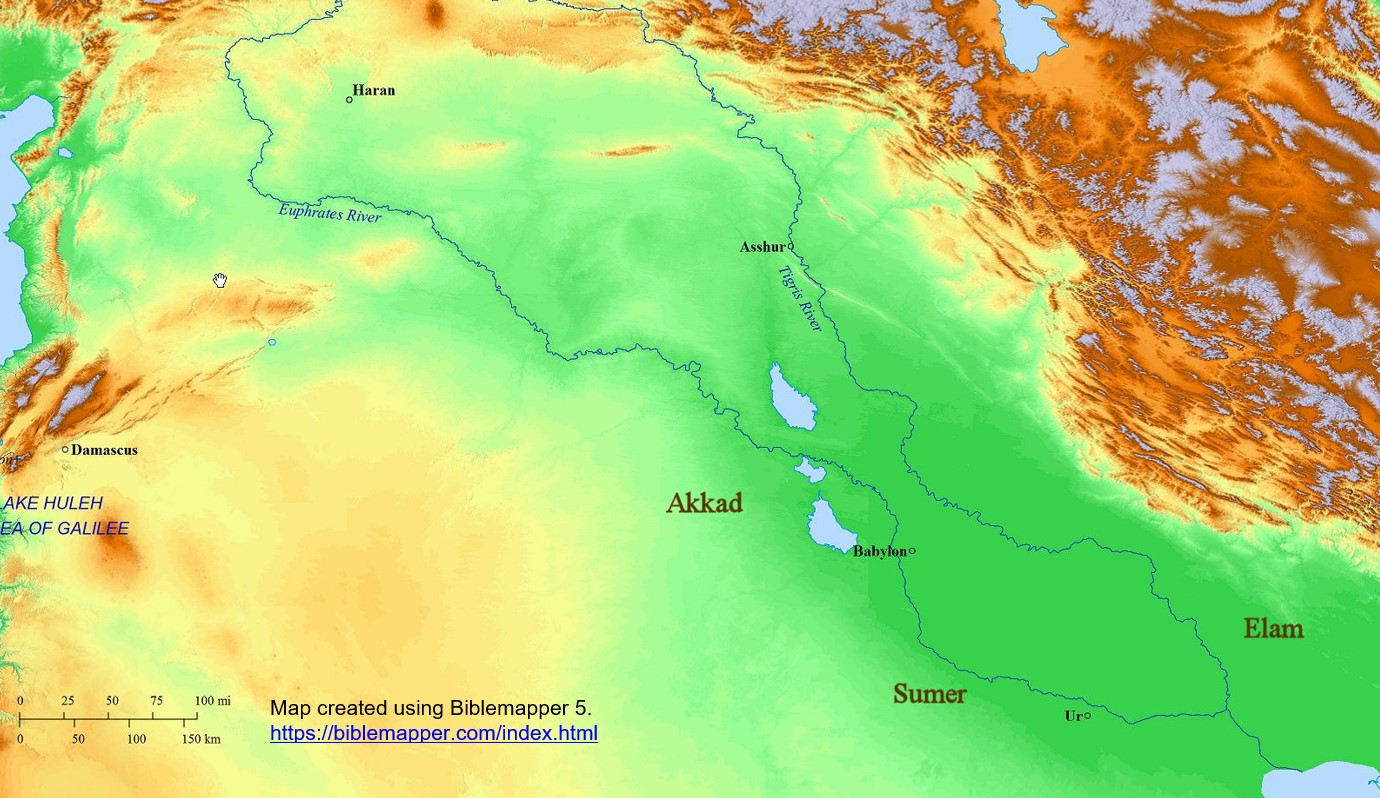
(It may be useful to hand out or display Map003 for this study). But be warned, the shape of the world today, may not have been the same before Genesis 10:25 - The Earth was divided. Specifically, Ur was once a maritime, port city, but massive sedimentation means it is now nearly 100 miles inland.
Now we continue in Genesis 11:10-27 – this was Terah’s tablet (v27), and was very specifically tracing just his own family line. Important to him, but important to us as it takes us to the birth of Abram.
10 . . . . Two years after the flood, when Shem was 100 years old, he became the father of Arphaxad. 11 And after he became the father of Arphaxad, Shem lived 500 years and had other sons and daughters.
12 When Arphaxad had lived 35 years, he became the father of Shelah. 13 And after he became the father of Shelah, Arphaxad lived 403 years and had other sons and daughters.
14 When Shelah had lived 30 years, he became the father of Eber. 15 And after he became the father of Eber, Shelah lived 403 years and had other sons and daughters.
16 When Eber had lived 34 years, he became the father of Peleg. 17 And after he became the father of Peleg, Eber lived 430 years and had other sons and daughters.
18 When Peleg had lived 30 years, he became the father of Reu. 19 And after he became the father of Reu, Peleg lived 209 years and had other sons and daughters.
20 When Reu had lived 32 years, he became the father of Serug. 21 And after he became the father of Serug, Reu lived 207 years and had other sons and daughters.
22 When Serug had lived 30 years, he became the father of Nahor. 23 And after he became the father of Nahor, Serug lived 200 years and had other sons and daughters.
24 When Nahor had lived 29 years, he became the father of Terah. 25 And after he became the father of Terah, Nahor lived 119 years and had other sons and daughters.
26 After Terah had lived 70 years, he became the father of Abram, Nahor and Haran.
27a This is the account of Terah.
It is possible to add the ages given and come up with a definitive number of years after the flood until Abram’s birth: 292. This means that using other Biblical dates we can arrive at a date of the flood around 4316 years ago. But here we enter the world of controversy, because not only are biblical scholars divided, suggesting 1072, 1172, or 942 years from the Flood to Abram, but also archaeologists demand several thousand years to fit their layers in and historians also struggle to match dates with contemporary records from other nations.
(If you find this interesting there are many theories to be found on the internet, but very few facts. I looked, but was spending far too much time so came back to this study!)
Historians suggest that the first civilisations in the world began in the ‘Fertile Crescent’. (Indicate on map) and using their dating we have:
9000bc – Early pottery is found.
8350bc – Jericho was a settlement of 4 acres
8000bc – Traces of the first cultivated cereals found in the Levant and to the south and east of the Dead Sea there were two farming settlements of over 24 acres.
7350bc – Jericho was a walled city of 10 acres (The first in the world).
7000bc – Copper is being worked.
6000bc – there was a settlement in Southern Turkey covering 32 acres containing ceramic pottery and other evidence of wealth such as obsidian and semi-precious stones. The houses had elaborate ornaments and wall paintings.
4000bc – saw the first bronze castings and the first use of the plough.
Remember that these discoveries only relate to a few sites and dates are best guesses that can’t really be relied upon, and are often revised.
As society develops, there will always be those who lead and those who are led. Consider the playground. A small group of boys forms a gang. One of them is the leader. As a gang they are quite likely to take sweets etc. from other boys. An astute boy asks ‘Can I join your gang?’ In order to join he may have to fight, or give something. But after that, he is accepted as part of the gang and he has its protection and a share in its winnings.
Early civilisation was just like that. If your tribe looked weak you would probably be raided by the stronger one from over the hill. It would be in your own interest (in fact - all your interests) to form an alliance (and maybe give some sheep or a wife to the head man). Once several tribes have grouped together they may be able to ward off an attack from any other tribe – or even be strong enough to carry out raids of their own.
As populations grew, tribes settled. With the introduction of copper tools and weapons, villages became towns and towns became cities. Chiefs became city leaders and started to call themselves kings. A strong king would attempt to gain dominance over adjoining cities, and all the people then under his authority would be expected to fight for the king and to provide him with goods and services. Ultimately, once an area was sufficiently populated and if the king was powerful enough, the land could be regarded as a country.
Once there was peace and stability in an area, traders would venture further afield, taking goods to sell or exchange. Some would stay in the new land, setting up permanent import/export businesses as they would have the contacts to source whatever they realised would be profitable.
The area around the coastal ends of the Euphrates and the Tigris became a cauldron as first one and then another of the city kings tried to gain supremacy.
Leadership of the area passed between Kish, Uruk and Ur. Although there was no central government, there was a unified culture, religion, and language. This language is today known as Sumerian and was one of a group of languages, including Hebrew, which are generally referred to today as Semitic.
We have seen how the descendants of Shem Ham and Japheth spread out across the world starting from Turkey. But it is thought the first true city was Uruk in Mesopotamia.
So let’s concentrate on Mesopotamia where civilisation is really taking off.
27b Terah became the father of Abram, Nahor and Haran. And Haran became the father of Lot. 28 While his father Terah was still alive, Haran died in Ur of the Chaldeans, in the land of his birth. 29 Abram and Nahor both married. The name of Abram’s wife was Sarai, and the name of Nahor’s wife was Milcah;
she was the daughter of Haran, the father of both Milcah and Iscah. 30 Now Sarai was barren; she had no children.
(At this point it may be helpful to draw a short family tree for Terah using just the facts from verses 27-30. Get people to call out names and relationships. We have no name for Haran’s wife, and Iscah – modern Jessica – is not mentioned again in the Bible. Chart002 has a more complete tree)
31 Terah took his son Abram, his grandson Lot son of Haran, and his daughter-in-law Sarai, the wife of his son Abram, and together they set out from Ur of the Chaldeans to go to Canaan. But when they came to Haran, they settled there.
32 Terah lived 205 years, and he died in Haran.
Why did Terah up sticks with the intention of moving to Canaan?
He appears to have been a successful businessman, perhaps a leader in his city. So it may have been a purely business decision – or were things getting too hot politically? Had he supported the wrong person for king? Or was there a more personal reason?
In Genesis 11:28 we read: While his father Terah was still alive, Haran died in Ur of the Chaldeans, in the land of his birth.
Was that the trigger to move, leaving his other son Nahor to carry on the family business? Did he take Haran’s body with him, with the intention of giving him a suitable burial somewhere else?
Or should we see the hand of God directing him? (‘I am the Lord, who brought you out of Ur of the Chaldeans to give you this land to take possession of it.’
Genesis 15:7)
Anyway he packs up and simply sets off up the main road. This was already a trade route from the head of the Persian Gulf to the Mediterranean, generally following the Tigris and Euphrates, and taking in Ur, Babylon, Nineveh, and Haran. Haran itself was at a crossroads where you could also head south to Caanan and Egypt or north to connect with the Silk Road to the East. It may not have been a town then, and it may not have had the name Haran until Terah arrived.
Remember, verse 31 says he intended to go to Canaan. So why did Terah change his mind at this point and settle in Haran?
When did it get that name? And why?
Logically, Terah would have named his town ‘Terah’ but maybe he wished to have a lasting memorial for his dead son.
It is possible that Terah and his people had been given the epithet ‘Hebrews’. Less than ten years after Abram had arrived in Canaan (16:3) he is referred to as ‘Abram the Hebrew’ (14:13). There are many references in ancient texts to the Abiru or Habiru - but sometimes more as a derogatory term for nomads, fugitives or bandits.
Now we will see how Terah's move would bring Abram from the mouth of the Euphrates, to Canaan.
Canaan: now there’s a name we’ve come across before – when was that? Genesis chapter 9 – which resulted in Canaan being cursed by God
Some people see the Devil’s hand in everything that goes wrong; others do not wish to credit him with anything. But it is a fact that he tries to frustrate God’s work on earth as much as he can. Here we see a cursed tribe occupying the very land that God has intended for his own people. I simply draw your attention to that!
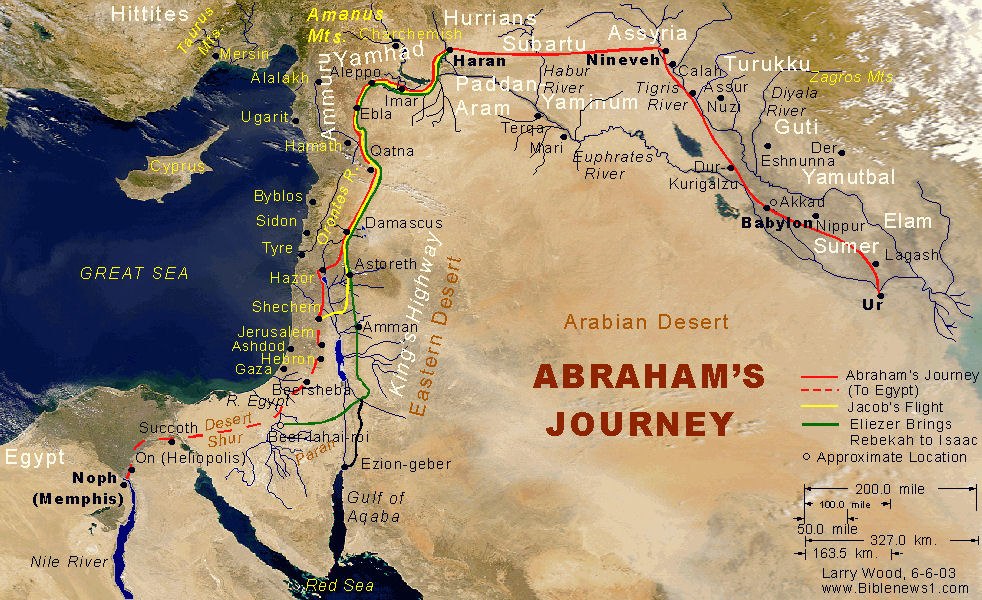
Map004 Abraham's journey
Before we move on we ought to notice where the main roads go through and round the land of Canaan:
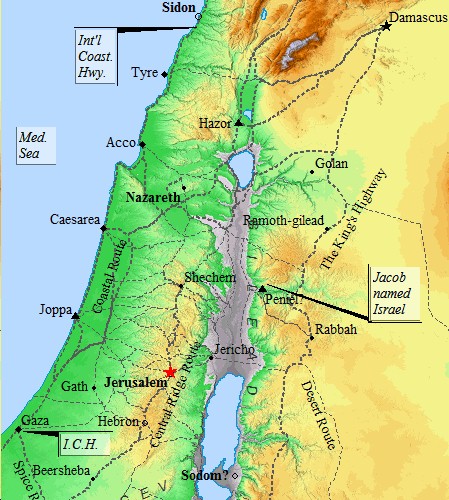
Map005 http://www.israel-a-history-of.com/old-testament-map.html"
Basically if you wanted to travel north-South you could go along the coast (but there were several rivers and swamps to negotiate)
- Or you could follow along the foothills – a more populated and thus dangerous route, but there was grass and water for the animals.
- Or you could go along the hilltops – better for defence - you could see people coming but there were several settlements there which could be good or bad.
- Or there was a route just the other side of the Jordan (again on the hilltops)
- Or, further east, along the foothills of those hills on the edge of the desert – little water or grass, but you could move relatively unimpeded.
The reason why there were only these routes was the nature of the land. Cutting into the hills from West to East there were several dried river beds with high vertical cliffs either side. Often the valleys were very narrow, but the cliffs made passage across impossible. This made North-South passage very difficult and defence relatively easy.
Do you remember a passage in the Old Testament when Shimei pelted David with stones and dust?
2 Samuel 16:5-6,13
5 As King David approached Bahurim, a man from the same clan as Saul’s family came out from there. His name was Shimei son of Gera, and he cursed as he came out. 6 He pelted David and all the king’s officials with stones, though all the troops and the special guard were on David’s right and left.
13 So David and his men continued along the road while Shimei was going along the hillside opposite him, cursing as he went and throwing stones at him and showering him with dirt.
Now our attention turns to Abram (Abraham – Genesis 17:5)
(It may be helpful for you to have read Galatians 3:1-26 before this study.)
Let’s read Genesis 12:1-8
1 The LORD had said to Abram, “Leave your country, your people and your father’s household and go to the land I will show you.
2 “I will make you into a great nation and I will bless you;
I will make your name great, and you will be a blessing.
3 I will bless those who bless you, and whoever curses you I will curse;
and all peoples on earth will be blessed through you.”
4 So Abram left, as the LORD had told him; and Lot went with him. Abram was seventy-five years old when he set out from Haran. 5 He took his wife Sarai, his nephew Lot, all the possessions they had accumulated and the people they had acquired in Haran, and they set out for the land of Canaan, and they arrived there.
6 Abram travelled through the land as far as the site of the great tree of Moreh at Shechem. At that time the Canaanites were in the land. 7 The LORD appeared to Abram and said, “To your offspring I will give this land.” So he built an altar there to the Lord, who had appeared to him.
8 From there he went on towards the hills east of Bethel and pitched his tent, with Bethel on the west and Ai on the east. There he built an altar to the LORD and called on the name of the Lord.
Look at verse 1. As with Noah, the Lord picks out the one man who will be able to carry out his plans. We are told nothing about his character although we can deduce that he listened to God and was obedient to his call.
Then we have the amazing verses 2 and 3!
2 “I will make you into a great nation and I will bless you;
I will make your name great, and you will be a blessing.
3 I will bless those who bless you, and whoever curses you I will curse;
and all peoples on earth will be blessed through you.”
God makes a covenant with Abram, which is developed later in Genesis.
What is a covenant?
(Often a one-sided promise of God’s intent, sometimes requiring reciprocal action from those with whom the covenant is made)
Let’s just notice some details as we go along. First v 4 ‘so Abram left’
Any comment?
How many people made up his party? (probably quite a lot – v5)
What do you understand by 'the people they had acquired in Haran’ (v5)?
Was there much baggage? (again, quite a lot + herds of animals)
How long was the journey? (500 or 600 miles)
Where did they stop? (Moreh at Shechem)
Where’s that? Look on maps
Would someone like to describe the scene in v7? (It doesn’t matter if no-one can; the question is intended to make everyone try to imagine it!)
Where next? (Bethel)
Where’s that? (12 miles north of Jerusalem)
So here we now have Abram and his tribe, arrived in the land that God has given him. He has received God’s covenant and blessing.
Don’t look at your bibles! – what do you imagine they will do next?