Recap:
Last time we had a look at Terah’s family tree and the beginnings of the move that would bring Abram from the mouth of the Euphrates, to Canaan.
Abram has at last arrived in Canaan. What will he do next?
Let’s read Genesis 12:9-20
9 Then Abram set out and continued towards the Negev. (Or Negeb)
What’s that? Negev=South, Negeb=Dry Draw a figure-of-eight on its side centred on Beersheba (on some maps it’s drawn as a very saggy eight!)
Why should he do that? Normally, wealth was counted in the size of flocks and herds you possessed. They needed pasture, and the dusty top of a mountain was not the best place to find that. And it seems he had settled into the life of a nomad, a Bedouin.
10 Now there was a famine in the land, and Abram went down to Egypt to live there for a while because the famine was severe.
In all probability Abram had never experienced drought conditions before. The Tigris and Euphrates were fed by consistent mountain streams, and Ur and Haran were both riverside locations.
The land of Canaan also had a different climate to that which we know today – it was a land flowing with milk and honey – which speaks of rich pastureland and many flowers. The area we would now describe as desert was once chosen by Lot: Genesis 13:10 Lot looked around and saw that the whole plain of the Jordan towards Zoar was well watered, like the garden of the LORD, like the land of Egypt. (This was before the LORD destroyed Sodom and Gomorrah.)
So for Abram famine was a shock. This was the land promised him by God, to which he had been led by God, yet it was now suffering from a severe drought. What’s going on? Is this a test?
Was it God’s will that Abram should move on from Bethel (v9)? Did God instruct him to go to Egypt (V10)?
(It is probably unfair to assume that as it is not recorded in the Bible, it was not God’s intention for Abram to go to Egypt. But Abram’s action does seem to have come out of a natural response from someone used to a method of farming where you moved from place to place, looking for grass for your animals, rather than having fields of your own.)
Up to now Abram has obediently followed the Lord’s guidance and entered the Promised Land without mishap. Faced with a problem, and trying to solve it himself, he is immediately faced with another problem.
11 As he was about to enter Egypt, he said to his wife Sarai, “I know what a beautiful woman you are. 12 When the Egyptians see you, they will say, ‘This is his wife.’ Then they will kill me but will let you live. 13 Say you are my sister, so that I will be treated well for your sake and my life will be spared because of you.”
What was Abram’s fear?
Here we have a whole tribe – many people (v5) and hundreds of animals moving into a new land looking for grazing. People will notice, and the information will be brought to the leader of this land (Pharaoh) as a potential threat, and he will investigate. He will then have several choices – (You could display these)
- He could simply kill or enslave the people and take their possessions and animals.
- He could accept payment in some form and then allow access.
- He could allow free access.
The first is quite likely, the third is most unlikely, the second is what Abram would prefer. But having a beautiful wife complicates matters. Pharaoh would in all probability want her for his harem. He would not want a married woman but that could easily be overcome by killing her husband. Having killed her husband, that might then open the door to the rest of solution one.
If instead she could be taken without strings, that would lead more naturally to solution two. Note here that the attitude to women was that they were valuable – but as items of property that could be used and traded much like any other possession.
Abram had formed a plan to enable him to provide food for his people and animals, but then he had to form another plan because his life was now in danger.
14 When Abram came to Egypt, the Egyptians saw that she was a very beautiful woman. (at 65! (v4, 17:17)) 15 And when Pharaoh’s officials saw her, they praised her to Pharaoh, and she was taken into his palace. 16 He treated Abram well for her sake, and Abram acquired sheep and cattle, male and female donkeys, menservants and maidservants, and camels.
Everything is looking good. Probably the famine in Canaan is now over but Abram’s visit to Egypt is proving profitable and he is in no hurry to return.
But what about his wife? Does Abram care about her feelings, her honour, her dignity? Does no one care that she is afraid and lonely? – God cares.
17 But the LORD inflicted serious diseases on Pharaoh and his household because of Abram’s wife Sarai.
Quite likely the women of the harem talked together. Probably they asked why such a beautiful woman had never married. As in all large establishments, those ‘below stairs’ often know more about people than those ‘above stairs’. But eventually the truth came out and Abram’s lie had to be addressed.
18 So Pharaoh summoned Abram. “What have you done to me?” he said. “Why didn’t you tell me she was your wife? 19 Why did you say, ‘She is my sister,’ so that I took her to be my wife? Now then, here is your wife. Take her and go!” 20 Then Pharaoh gave orders about Abram to his men, and they sent him on his way, with his wife and everything he had.
Even in the ‘heathen’ culture of Egypt, lying to the Pharaoh was unthinkable. To discover that someone you had grown to respect had lied to you over such a personal matter was an outrage. V18: “What have you done to me?” he said.
Abram was fortunate to escape with his life: 20 Then Pharaoh gave orders about Abram to his men, and they sent him on his way, with his wife and everything he had.
Read Genesis 13:1-4
1 So Abram went up from Egypt to the Negev, with his wife and everything he had, and Lot went with him. 2 Abram had become very wealthy in livestock and in silver and gold.
3 From the Negev he went from place to place until he came to Bethel, to the place between Bethel and Ai where his tent had been earlier 4 and where he had first built an altar. There Abram called on the name of the Lord.
Abram had come back. Back to the Promised Land and back to the Lord. We don’t have the discussion between Abram and God recorded for us (end of verse 4) but can anyone imagine what it would have been?
Hopefully now Abram will look to the Lord for his future direction.
Read Genesis 13:5
5 Now Lot, who was moving about with Abram, also had flocks and herds and tents.
Lot could well have been in his 40s and was well established with his own flocks, herds and people to look after them (‘tents’ v5). But with Abram’s animals and people, and the fact that the Canaanites and Perizzites were also living in the land at that time (v7), finding pasture land was becoming more and more of a problem, and led to quarrels.
Read Genesis 13:6-7
6 But the land could not support them while they stayed together, for their possessions were so great that they were not able to stay together. 7 And quarrelling arose between Abram’s herdsmen and Lot’s. The Canaanites and Perizzites were also living in the land at that time.
Magnanimously, Abram suggests they separate, with Lot choosing where he would like to go (Genesis 13:8-11):
8 So Abram said to Lot, ‘Let’s not have any quarrelling between you and me, or between your herdsmen and mine, for we are close relatives. 9 Is not the whole land before you? Let’s part company. If you go to the left, I’ll go to the right; if you go to the right, I’ll go to the left.’
10 Lot looked around and saw that the whole plain of the Jordan towards Zoar was well watered, like the garden of the Lord, like the land of Egypt. (This was before the Lord destroyed Sodom and Gomorrah.) 11 So Lot chose for himself the whole plain of the Jordan and set out towards the east. The two men parted company:
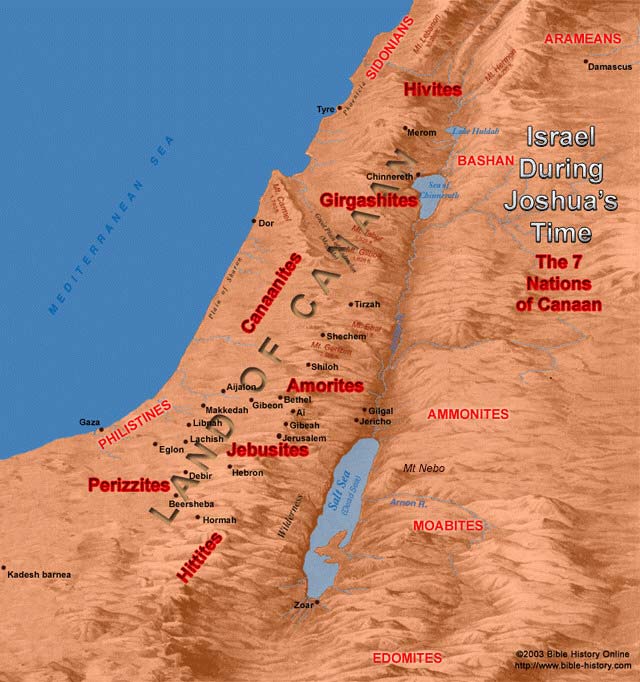
We mentioned in our previous study that the climate in Israel has changed dramatically since Abram’s time. In his day, the area surrounding the river Jordan, all the way to south of the Dead Sea, was a rich fertile plain (v10). (The Sahara Desert was once a green and pleasant land too!)
The Dead sea was a lot smaller at that time, the whole southern end was fertile dry land and the towns of Sodom and Gomorrah were there.
It is possible that the Dead Sea itself was a freshwater sea (like the Sea of Galilee to the north. The present levels of contamination, with 25% Chloride and Bromide salts, may only have occurred after the violent events which caused the destruction of Sodom and Gomorrah. Hot sulphur springs still contribute to the mineral content to this day.
If you are at Bethel, on the crest of the North-South ridge, the choice is simple and obvious: either go west towards the lowland plains by the Mediterranean or go east to the Jordan valley.
11 So Lot chose for himself the whole plain of the Jordan and set out towards the east. The two men parted company: 12 Abram lived in the land of Canaan, while Lot lived among the cities of the plain and pitched his tents near Sodom. 13 Now the people of Sodom were wicked and were sinning greatly against the Lord.
What do you make of Lot’s decision?
We must be careful not to be too critical of Lot: look at 2 Peter 2:7-8
7 and if he rescued Lot, a righteous man, who was distressed by the filthy lives of lawless men 8 (for that righteous man, living among them day after day, was tormented in his righteous soul by the lawless deeds he saw and heard)
It was a poor choice perhaps, and not the choice for Abram – he would now be more careful where he went!
14 The Lord said to Abram after Lot had parted from him, ‘Look around from where you are, to the north and south, to the east and west. 15 All the land that you see I will give to you and your offspring for ever. 16 I will make your offspring like the dust of the earth, so that if anyone could count the dust, then your offspring could be counted. 17 Go, walk through the length and breadth of the land, for I am giving it to you.’
What an amazing thing for Almighty God to say to a man who makes mistakes! In what way should that encourage us?
18 So Abram went to live near the great trees of Mamre at Hebron, where he pitched his tents. There he built an altar to the Lord.
Why Hebron?
It is at the highest point on the main north/south Ridge Route and it is here that it branches – from the north, to the southeast and southwest. It had already become a trading centre and because it was the highest point (over 3000ft) its elevated position could be more easily defended (and you could see people approaching on the roads from a long way away).
It also meant that the rainfall was higher (currently around 40 inches a year) and the average temperature ranges from 8°C in winter to 23°C in summer so a significant variety of crops could be grown in the surrounding countryside.
There were of course people living there already, but Abram’s tribe by now numbered 318 trained fighting men (Genesis 14:14) and was a force to be reckoned with. Probably a deal was agreed with Mamre and his two brothers who appeared to be the tribal leaders living there (Genesis 14:13,24), and they settled into a harmonious partnership.
I guess only Abram’s close family actually lived there as the headquarters of his tribe. The rest would have spread out towards the coast with the animals.
(If people query the numbers of men in Abram’s household, Genesis 17:13 refers to men ‘born in your household or bought with your money.’ This appears to suggest that the purchase of slaves was commonplace, although they were more likely to have been treated as employees, or simply part of the extended family. See also Genesis 12:16)
Notice too that here Abram built an altar to the Lord. Obviously worship was already an important part of Abram’s life, but now –
Can someone describe how Abram felt after Genesis 13:14-17?!